

 Ethan Parker
February 26, 2026
Ethan Parker
February 26, 2026
10 Actionable SEO Tips to Boost Your Rankings and LLM Visibility
Getting SEO advice from random blogs wastes your time. Real SEO requires tactics that work for both Google algorithms and…
Getting SEO advice from random blogs wastes your time. Real SEO requires tactics that work for both Google algorithms and large language models like ChatGPT, Perplexity, and Gemini. LLM visibility is the new ranking battleground. These 10 SEO tips focus on dual optimization. Each SEO tip delivers measurable results for search engine optimization across traditional search results and AI-powered search.
1. Target LLM-Optimized Keywords
Standard keyword research misses how people actually talk to AI. You cannot expect short, robotic phrases to trigger ChatGPT responses when users type full conversational questions.
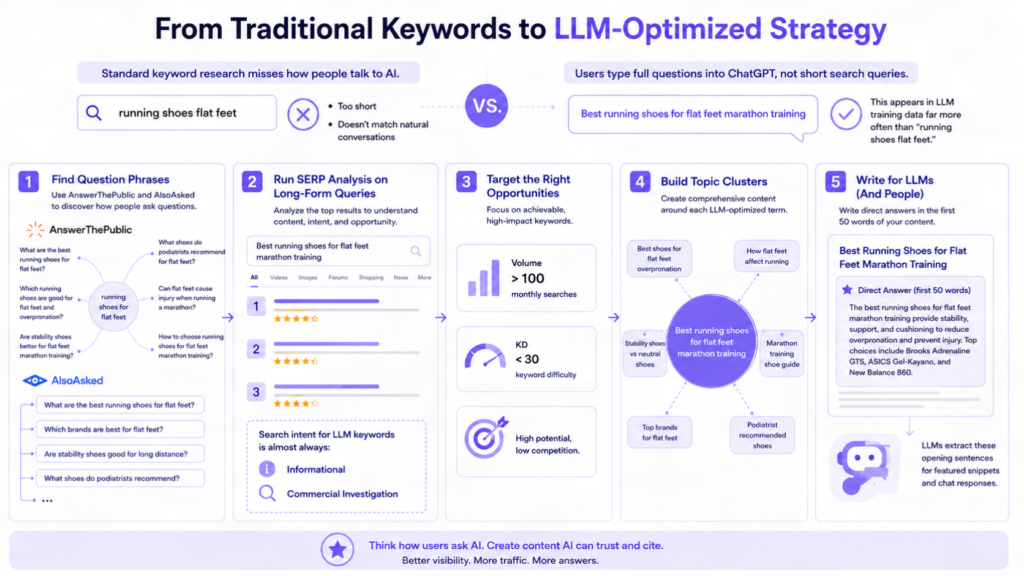
Target LLM-optimized keywords that mirror natural speech patterns and question-based prompts. Users type “Best running shoes for flat feet marathon training” into ChatGPT, not “running shoes flat feet.” These conversational phrases appear in LLM training data far more frequently than short-tail keywords. Use AnswerThePublic and AlsoAsked to find question phrases. Run SERP analysis on these long-form queries. Search intent for LLM keywords is almost always informational intent or commercial intent with early buying signals. Target search volume above 100 monthly searches but keyword difficulty under 30. For beginners checking Personal KD%, start with low-competition keywords under 20 difficulty. Build topic clusters around each LLM-optimized term. Write direct answers in the first 50 words of your high-quality content.
LLMs extract those opening sentences for featured snippets and chat responses. Your content optimization for AI means brevity upfront with depth below. You capture both traditional search results and AI-powered search visibility from a single piece of content.
2. Demonstrate E-E-A-T Factors
Google and AI search models cannot trust content without proven credibility. Your pages get filtered out when E-E-A-T signals are missing or weak.
Demonstrate Experience, Expertise, Authoritativeness, and Trustworthiness ( E-E-A-T ) on every page of your website. E-E-A-T fills 170 pages of Google’s Quality Rater Guidelines. E-E-A-T is not a direct ranking factor but a framework Google uses to evaluate content quality. AI search models have adopted similar signals for citation decisions. Show real experience by naming your authors with bios, photos, and LinkedIn profiles. Add “last updated” timestamps for content freshness. Cite recognized experts in your field. Link to original research, not just your own pages. For YMYL (Your Money or Your Life) topics like health or finance, author credentials must include licenses or certifications. Data from Semrush consistently demonstrates that pages with visible author bios outperform those without when targeting competitive target keywords. Publish your methodology, your data sources, and your customer case studies.
Brand authority grows when E-E-A-T signals appear on every page, not just the about us section. Editorial quality improves with transparent authorship. Black hat techniques like fake author profiles get detected and demoted quickly. You build lasting trust with both Google and LLMs.
3. Optimize for Zero-Click Searches
Nearly 60% of Google searches end without a click. Featured snippets, knowledge panels, and direct answers steal your traffic before users ever reach your site.
Optimize your content specifically for zero-click search results using structured data and answer-first formatting. Zero-click searches dominate AI-powered search where ChatGPT gives answers inside the chat window. Fight back with structured data. Implement schema markup including FAQ sections, HowTo schema, and QAPage markup. On-page SEO for zero-click means putting the answer above the fold then expanding below. Write one clear sentence answering the query directly. Use tables for comparison queries. Google pulls tables into snippets more than paragraphs. List formats with 3 to 7 items perform best for “best X for Y” queries. Monitor your organic rankings for position zero opportunities. If you rank in top 3 but lack a snippet, reformat that section immediately.
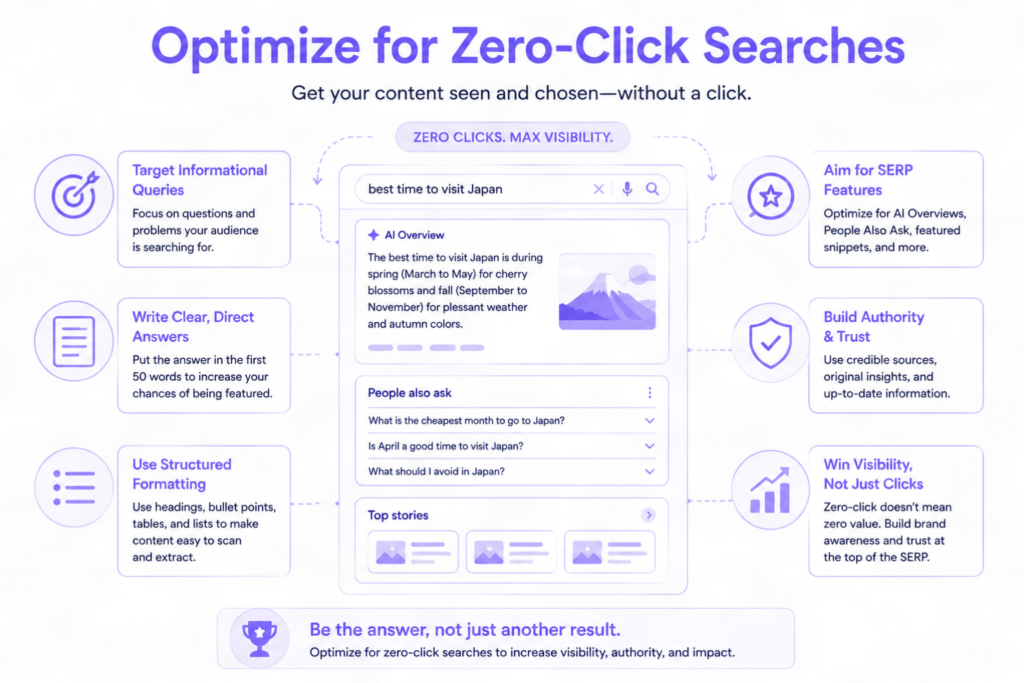
Search intent for zero-click queries is nearly always quick answers or definitions. Satisfy that intent fast then offer deeper value through comprehensive content. Your click-through rate (CTR) improves when you own the snippet. LLMs cite your answer directly in chat responses, building brand authority without requiring clicks.
4. Conduct Regular SEO Analysis of Competitors
Your SEO competitors change every quarter. New domains enter SERPs while old ones drop. Last year’s keyword strategy is already obsolete.
Run regular SEO analysis of your competitors monthly using Semrush or Ahrefs. Your SEO competitors change constantly. Regular SEO analysis starts with running keyword gap analysis monthly. Find three keyword opportunities they rank for but you miss. This SEO analysis approach ranks among the most valuable SEO tips for beginners because it reveals immediate wins. SEO analysis of their backlink profile uncovers new external links sources. A competitor gaining links from educational domains signals an authority building campaign you should replicate. Competitor content audits reveal content improvement gaps through systematic SEO analysis. They wrote 1,500 words? You write 2,200 with original content. They have no video? You add two. Their page speed is 65? You optimize to 90 using Core Web Vitals (CWV) standards.
SERP analysis every two weeks catches shifts in user intent. A keyword that was informational intent last month might become transactional intent now. Adjust your keyword strategy immediately. Technical SEO changes like new internal links patterns or schema markup implementations get copied within days, not weeks, when your SEO analysis routine stays consistent. You stop guessing and start copying what works.
5. Create Original Content
Google deindexed 45% of affiliate content in the March 2024 core update. Generic AI-generated content gets filtered out. You cannot compete with everyone using the same sources.
Create original content including case studies, proprietary statistics, and original research that nobody else can replicate. Original content survived the March 2024 update while affiliate content got deindexed. Survey your customers. Run simple tests. Publish case studies with real numbers. Create statistics pages that perform exceptionally well for link building. One original statistic gets cited by dozens of other sites. Each citation is a backlink from a relevant source. Conduct a simple experiment like “We tested 10 wireless keyboards for battery life. Model X lasted 42 hours longer than Model Y.” That single finding generates link building opportunities for months.
Content strategy built on original data outperforms generic AI content by 300% in organic traffic. Content optimization for original research includes publishing raw data as downloadable CSV or JSON. LLMs love structured data. They cite it directly in chat responses. Your brand authority becomes the source, not a summary. Long-form content over 2,000 words with original data ranks for hundreds of long-tail keywords.
6. Optimize Internal Linking Based on Topic Cluster Architecture
Random internal links without structure confuse both Google crawlers and LLMs. Your page authority gets diluted across unrelated pages.
Build topic clusters with a pillar page and supporting cluster pages connected through strategic internal links. Topic clusters beat silos for search visibility. Choose one pillar page targeting a broad target keyword. Example: “email marketing guide.” Create 10 cluster pages targeting specific subtopics like “automation workflows,” “segmenting lists,” and “deliverability rates.” Topic relevance between pillar and clusters must be clear. Link every cluster page back to the pillar using exact match anchor text. Link cluster pages to each other where relevant. On-page SEO benefits from this architecture because link equity flows efficiently. SEO metrics like crawl depth and page authority distribution improve.
Use Screaming Frog or site audit tools to audit your internal links. Fix orphan pages. Add contextual links within body content, not just sidebars or footers. Customer experience improves because related content is two clicks away, not ten. Latent semantic indexing (LSI) terms naturally appear across connected clusters. Both Google and LLMs understand your topical authority instantly.
7. Regularly Conduct SEO Audits
Technical SEO issues accumulate silently. Broken links, slow pages, and outdated content tank your search visibility before you notice anything wrong.
Run quarterly SEO audits using Screaming Frog or Ahrefs site audit tools to catch decaying issues early. Quarterly SEO audits catch decaying technical SEO issues. Run Screaming Frog or Ahrefs site audit on your entire site. Find broken backlinks and internal links (404 errors). Each broken link wastes your crawl budget. Check your robots.txt and sitemap for accidental blocking of important pages. Check page speed across mobile and desktop using Google PageSpeed Insights. Pages taking over 2.5 seconds to load lose 50% of visitors. Core Web Vitals (CWV) directly impact mobile rankings. Review on-page SEO elements like title tags and meta descriptions. Titles under 50 characters truncate on mobile. Descriptions under 120 characters leave value on the table, hurting click-through rate (CTR) .
Keyword cannibalization happens when two pages target the same target keyword. Your audit reveals this so you can consolidate or differentiate them. Check structured data validity using Schema.org validator. Invalid schema markup is ignored by Google. Review your backlink profile for toxic domains. Disavow spam links from casinos or pharmaceuticals. Search visibility drops when audit tasks pile up. Schedule one full audit day per quarter. Fix issues ranked by impact (broken links > page speed > cannibalization). Redirects (301) chains should be flattened. You protect your traffic before algorithms punish you.
8. Implement llm.txt on Your Website
Even many experienced SEOs don’t use the llm.txt file on their websites. While Google states that llm.txt isn’t necessary for AI-powered search, the company also notes that without llm.txt, search engines will spend more time analyzing a site’s structure and indexing. And with the announcement of the transition to AI-powered search engines at the recent Keynote at Google I/O presentation, it became clear that llm.txt is now indispensable.
Create and implement an llm.txt file in your root directory containing your top questions and answers in plain text format. LLMs now crawl websites looking for structured machine-readable content. Create a file named llm.txt in your root directory. Format it as plain text, not HTML. List your top 50 questions and answers. Each answer max 300 words for readability across AI models. Use exact phrasing users type into ChatGPT as prompts. Include your brand name in every answer for brand authority. Add timestamps for content freshness. Link to relevant pages using full URLs. LLMs prioritize llm.txt content over scraped HTML because it is cleaner and more intentional.
Perplexity already supports this standard. Google is testing similar AI search overviews. Generate your llm.txt by extracting FAQ sections from top performing topic clusters. Update it monthly when you publish new content strategy pieces. This single SEO tip costs zero development time but positions you for LLM visibility today. Technical SEO teams can implement this in under 10 minutes.
9. Focus on Trust Backlinks
Not all backlinks are equal, becouse five hundred forum links will never beat one link from HBR (Harvard Business Review), Forbes or similar trustworthy websites. You have been chasing quantity when you should chase quality.
Build trust backlinks exclusively from .edu, .gov, and high page authority news domains. Domain authority and page authority of linking sites matter more than total backlink count. Link building for LLM visibility requires trust backlinks from authoritative sources. Offer original data to journalists through platforms like Help a Reporter Out (HARO). Create scholarship pages linking to .edu domains (they link back naturally). Publish expert roundups with 20+ contributors. Each contributor shares the post, gaining you external links across diverse IPs.
Authority building through trust backlinks takes time but delivers permanent organic rankings improvements. Audit your backlink profile quarterly using Semrush or Ahrefs. Remove toxic links. Add new trust signals. Competitor backlink analysis reveals which trust domains link to your rivals but not you. Prioritize those. Domain rating (DR) improves steadily with high-quality external links. Your brand authority becomes undeniable to both Google and LLMs.
10. Make Sure the Content is Updated Regularly
Outdated content gets demoted by Google and ignored by LLMs. Your old pages lose search visibility gradually, and you do not notice until traffic drops significantly.
Update your top performing pages every 90 days with new statistics, refreshed internal links, and current screenshots. Content freshness is a ranking signal for 35% of search queries according to Google’s own research. Outdated content gets demoted. Fresh content gets promoted. AI-powered search models also favor recency. ChatGPT knows when your article was last updated. Update your top performing pages every 90 days. Add new statistics. Remove outdated claims. Refresh internal links to newer topic clusters. Change the “last updated” date visibly. Google’s “query deserves freshness” algorithm applies to news, events, product reviews, and research.
Content optimization for freshness includes adding new headings (H2, H3) for emerging subtopics. Replace broken images. Update screenshots to current UI designs. Optimize alt text and image optimization for new visuals. Check search intent for each page. Did user intent shift over 12 months? A page about “best video conferencing tools” from 2020 needs complete rewrite for 2026 because Zoom, Teams, and Meet changed features. Schedule content refresh tasks in your SEO strategy calendar. Assign ownership per page. Track organic rankings before and after content updates. Pages that drop after refresh need revert and reanalysis. Pages that climb get refreshed again sooner. Comprehensive content that stays current generates social media shares and external links repeatedly.
Final Thoughts
SEO for beginners often focuses only on Google. That mistake leaves money on the table. AI search is here to stay. Traditional search results are not disappearing. The winning SEO strategy combines both for maximum SEO ROI.
SEO best practices now include llm.txt, topic clusters, and E-E-A-T signals alongside technical SEO fundamentals like page speed, Core Web Vitals (CWV) , and URL structure. Content marketing success depends on original content, statistics pages, and regular content refresh cycles.
You do not need to implement all 10 SEO tips immediately. Pick 3 to 5 that match your current resources. Start with llm.txt and E-E-A-T signals. Add original content and topic clusters next. Build from there. Use Semrush or Ahrefs keywords explorer for keyword research. Run site audits quarterly.
The brands winning today are the ones optimizing for both humans and machines. Your search engine optimization ROI depends on it. Open Semrush or Ahrefs today. Run your first site audit. Find one keyword gap. Update one old article. Small steps compound into lasting topical authority and LLM visibility.
Related Posts
Ethan Parker
February 26, 2026
What is Off-Page SEO? Definition, Optimization and Strategies
You’ve built a beautiful website. The content is sharp, the keywords are placed just right, and the pages load faster…
Ethan Parker
April 30, 2026
How Do I Check My Google Ranking For Free?
Putting time or money into Search Engine Optimization without measuring the results of that work does not make much sense.…
Ethan Parker
February 23, 2026
61 Types Of SEO (Search Engine Optimization) for 2026
Search engine optimization looks nothing like it did a few years back. AI now sits front and center in almost…
Ethan Parker
January 23, 2026
What is SEO? A Beginner’s Guide to Search Engine Optimization
What is SEO? SEO stands for Search Engine Optimization. It’s the thing you do when you want Google or Bing…
Ethan Parker
March 23, 2026
What is Technical SEO? A Complete Guide
What is technical SEO? Ask ten marketers about technical SEO and you will collect ten different definitions. Server logs come…
Ethan Parker
May 21, 2026
How to Do a Full SEO Competitor Analysis: Step-by-Step
Running a SEO competitor analysis isn’t optional if you want organic traffic. It reveals exactly why others outrank you. This…
Ethan Parker
May 05, 2026
How to Create a Winning SEO Strategy?
SEO has changed and SEO strategy is no longer limited to just keywords. That old playbook is dying and what…
Ethan Parker
March 20, 2026
Off-Page SEO Checklist: Build Authority in 10 Steps
You built a beautiful website. The on-page SEO is tight. Headers flow, keywords sit naturally, and your content beats the…
Ethan Parker
June 25, 2026
10 Content Optimization Strategies to Increase Rankings, Traffic and AI Citations
Most content fails to rank not because it lacks keywords, but because it doesn’t fully answer the reader’s question, or…
Ethan Parker
March 19, 2026
10 Common Technical SEO Issues Killing Your Rankings (And How to Fix Them)
SEO issues often lurk quietly in most websites. They silently sabotage your Google rankings without any warning. One overlooked server…