
 Ethan Parker
March 19, 2026
Ethan Parker
March 19, 2026
10 Content Optimization Strategies to Increase Rankings, Traffic and AI Citations
Most content fails to rank not because it lacks keywords, but because it doesn’t fully answer the reader’s question, or…
Most content fails to rank not because it lacks keywords, but because it doesn’t fully answer the reader’s question, or it answers it so poorly that Google won’t surface it, and AI tools won’t cite it.
Content optimization is the process to improve a page so search engines understand it, readers find it useful, and AI systems trust it enough to reference. This article covers 10 strategies that address all three.
What counts as content optimization
Content optimization is not keyword stuffing. It is not rewriting sentences to hit a density target. It means making sure your content:
- Matches what the searcher actually wants
- Covers the topic with enough depth that a reader doesn’t need to go elsewhere
- Signals to Google and to AI systems like ChatGPT, Perplexity and Google’s AI Overviews, that you are a credible source
- Loads fast, reads clearly, and leads the reader somewhere useful
Technical SEO (crawlability, Core Web Vitals, site architecture) is a separate discipline. These strategies focus on the content itself.
1. Audit Your Content Before You Optimize It
You cannot prioritize what to fix if you don’t know what you have. Start with an audit before you touch a single page.
A content audit maps every URL on your site to its performance data and assigns each one a status:
- Keep: Performing well. No action needed.
- Improve: Has traffic potential but performs below expectations. Optimize it.
- Consolidate: Overlaps with another page. Merge the two into one stronger page.
- Remove: No traffic, no ranking potential, no strategic value. Delete and redirect.
How to start content audit
- Export all URLs from your sitemap or crawl the site with Screaming Frog
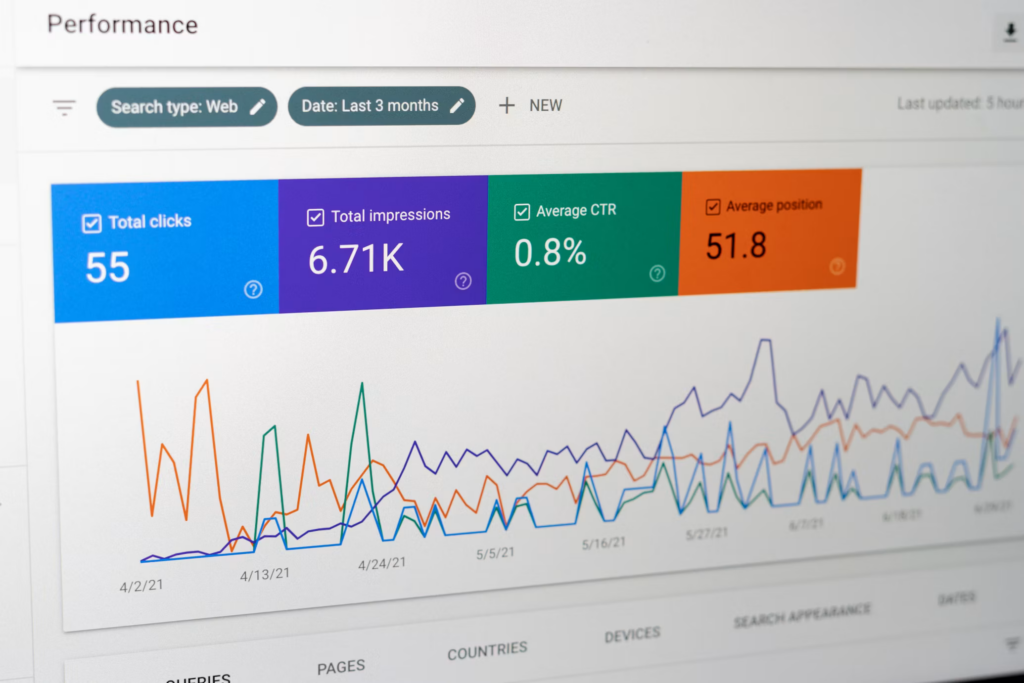
- Pull impressions, clicks, and average position from Google Search Console
- Pull sessions and conversions from your analytics tool
- Assign each URL to one of the four buckets above
Prioritize “Improve” pages that already rank between positions 11–30 for their target keyword. These pages are closest to meaningful traffic gains. A page ranked on page two of Google requires less effort to reach the first page than a page buried on page five.
2. Match Every Page to Search Intent
Before writing or rewriting content, confirm what the top search results actually show for your target keyword. Google’s first page tells you the format and depth that already satisfies searchers.
If all top results are listicles and you publish a 400-word definition, you will not rank — not because of word count, but because the format mismatches what searchers want.
Check three things:
- Intent type: Are searchers looking to learn, compare, buy, or find a specific page?
- Format: What structure do the top 5 results use: listicle, how-to, tool, definition?
- Depth: Which subtopics appear across multiple ranking pages?
Your content must satisfy the same intent using the same basic format. Differentiate on quality and completeness, not through total neglect of the format
Use Google’s ‘People Also Ask’ and ‘Related searches’ to find subtopics searchers expect you to cover. If competitor pages cover a subtopic and yours does not, you have a gap. Fill it.
3. Optimize On-page Elements
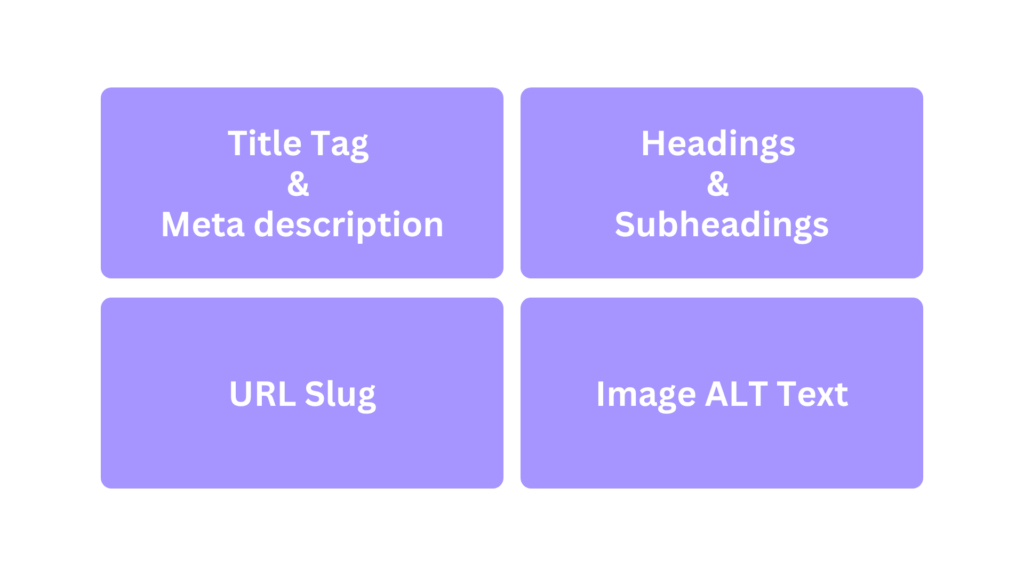
On-page elements are the HTML signals Google reads first. Get them right before anything else. Recommendations for optimizing on-page elements to improve SEO:
- Title tag: Include your primary keyword. Keep it under 60 characters. Write it for the searcher because it appears in search results and must earn a click
- Meta description: Not a direct ranking factor, but it influences click-through rate. Keep it under 155 characters. State clearly what the reader will get
- H1: One per page. Should match or closely reflect your title tag. Include the primary keyword
- H2 and H3 subheadings: Structure the page logically. Include secondary keywords where they fit naturally, but do not force them. Place a subheading every 200–300 words
- URL slug: Short, lowercase, hyphenated, keyword-relevant. /content-optimization-strategies beats /the-10-best-content-optimization-strategies-for-seo-in-2025
- Image ALT text: Describe what the image shows. Include a keyword only if it fits naturally. Alt text is indexed by Google Images and read by screen readers
- Canonical tag: Set on every page to tell Google which URL is the authoritative version
4. Depth First Readability Second
Depth means covering the topic completely enough that the reader doesn’t need another page. Readability means making that coverage easy to absorb.
On Depth
Use specific language. “Loading time matters” is vague. “Pages that load in under 2 seconds on mobile have 15% lower bounce rates than pages that load in 4 seconds” is specific and verifiable. AI systems cite specific, attributed claims, but they ignore vague assertions.
Cover every subtopic a reader would need to fully understand the subject. If a competitor covers something you don’t, and it’s genuinely useful, add it.
On Readability
Use short paragraphs of three lines maximum on desktop. Keep one idea per paragraph and use an active voice and avoid sentences that require re-reading to parse.
Do not pad. A 3,000-word article with 1,000 words of filler does not outperform a focused 2,000-word article. Google’s Helpful Content system is built to demote padded content. AI systems are trained to prefer precise, well-structured text over verbose filler.
5. Build E-E-A-T Signals Throughout
E-E-A-T stands for Experience, Expertise, Authoritativeness, and Trustworthiness. Google’s quality raters use it to evaluate content. It also governs what AI systems trust enough to cite.
AI models that power ChatGPT, Perplexity, Claude, and Google’s AI Overviews are trained on and retrieve content that demonstrates genuine authority. Thin, unsourced, or anonymous content rarely appears in AI citations.
Practical steps to strengthen E-E-A-T:
- Name and credential the author. Add an author bio with relevant experience and links to other published work or a professional profile.
- Cite primary sources. Link to the original study, government dataset, or official documentation. Do not link to a blog post that summarizes it.
- Demonstrate first-hand experience. If you’re writing about a tool, show you’ve used it: screenshots, specific observations, honest limitations. Don’t imply expertise you don’t have.
- Keep information current. Outdated statistics and dead links are trust signals going the wrong direction.
- Get expert review on YMYL topics. For health, finance, legal, or safety content, have a subject matter expert review the piece before publishing.
6. Target Featured Snippets and AI Overviews
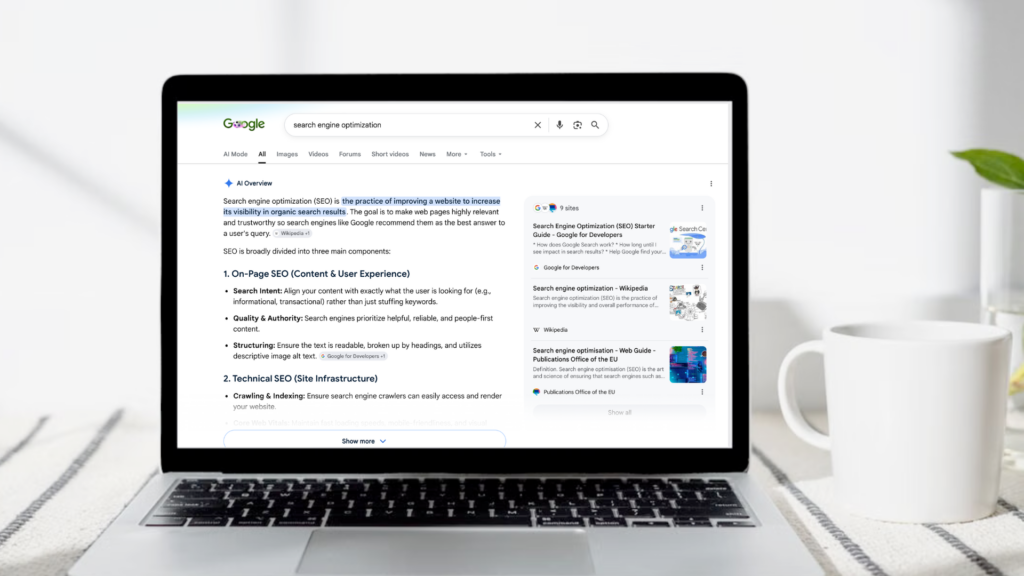
Featured snippets are the boxed answers Google shows above organic results. AI Overviews are Google’s AI-generated summaries shown for informational queries. Both can reduce direct clicks, but appearance in them increases visibility and drives brand recognition at scale.
To Target Featured Snippets
- Find keywords where a snippet currently appears (Ahrefs and Semrush both filter for this)
- Answer the query directly in 40–60 words immediately after the relevant H2
- Use the question as your subheading, phrased exactly as searchers ask it
- For list snippets, use clean numbered or bulleted lists with items under 12 words each
- For table snippets, use an HTML table with a clear header row
To Appear in AI Overviews and AI Citations
AI Overviews pull from pages Google already trusts for a topic. There is no direct submission process. The path is: rank well organically, demonstrate E-E-A-T (Strategy 5), and structure your content so key answers are easy to extract.
Perplexity and ChatGPT with web search cite pages that are indexed, crawlable, and contain specific, attributed claims. Structure your most citable content (definitions, statistics, and step-by-step processes) as standalone sections with descriptive H2 headings. An AI system that extracts an answer on your page should be able to lift a section and have it make sense without the surrounding context.
7. Add Internal Links and Schema Markup
Internal links connect your content to the rest of your site. Every page should link to at least two or three related pages on your site, using descriptive anchor text. Do not use “click here” or “read more.”
Internal links serve two purposes: they pass authority between pages, and they give Google context about what your other pages cover. A page with no internal links pointing to it is nearly invisible to Google.
Schema markup is structured data in your page’s HTML that tells Google explicitly what type of content the page contains. Google uses it to generate rich results like FAQ dropdowns, how-to steps, and star ratings. These increase your visibility in search.
For most content:
- Article schema: Identifies the page as an article with a headline, author, and date published
- FAQ schema: Marks up Q&A sections for rich result dropdown display
- HowTo schema: Marks up step-by-step instructions
Add schema as JSON-LD in the <head> of your page. Test it with Google’s Rich Results Test before publishing.
Schema also helps AI systems understand your content’s structure. Pages with clear structured data are easier to parse and more likely to be cited accurately.
8. Refresh Content That Is Out of Date
Content decay is inevitable. Rankings drop as competitors publish better pages and information becomes outdated. A refresh is not a light edit. It is a systematic update that makes the page more complete and more competitive than the pages currently outranking it.
When to refresh (not rewrite):
- The page ranks between positions 5–20
- The core information is accurate but incomplete or outdated
- The page lacks subtopics that ranking competitors cover
When to rewrite:
- The page targets the wrong keyword
- The format doesn’t match current SERP intent
- The content is thin throughout, not just outdated in sections
When to consolidate:
- Two pages on your site compete for the same keyword (see Strategy 9)
- Neither is strong enough to rank alone
- Merging their content into one page is feasible
When to delete and redirect:
- The page has received zero organic traffic in 12 months
- The topic is no longer relevant to your readers
- No amount of optimization would make it competitive
Update the publish date only after making substantive changes. Changing a date without content updates is a manipulative signal Google’s systems are built to catch.
9. Fix Keyword Cannibalization
Keyword cannibalization happens when two or more pages on your site compete for the same keyword. Google divides attention between them, and neither ranks as well as one consolidated page would.
How to Identify and Fix Keyword Cannibalization
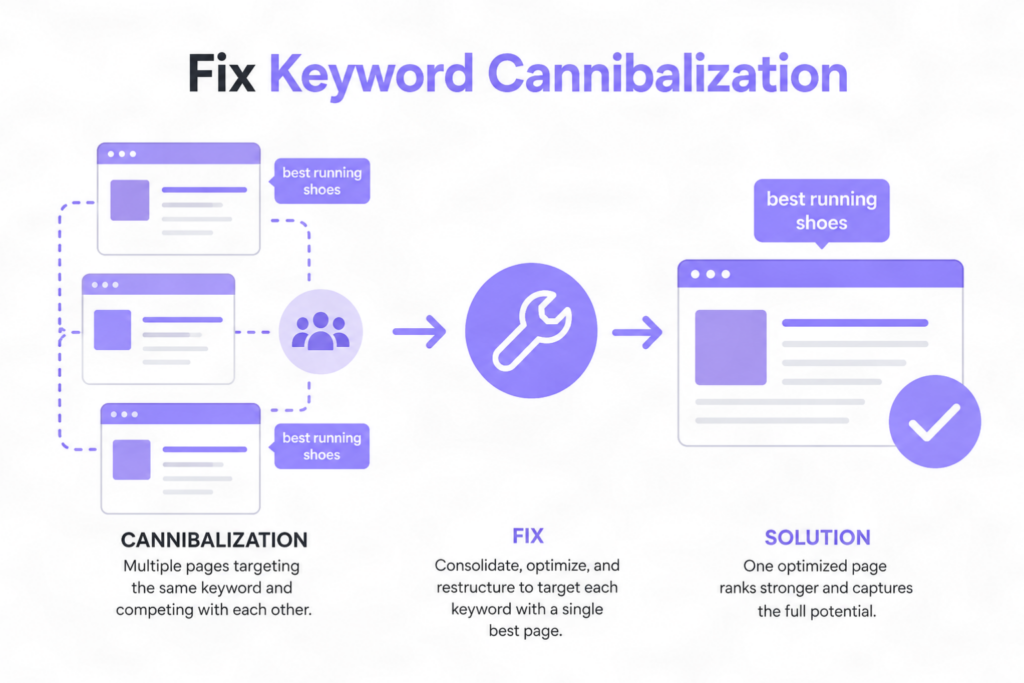
In Google Search Console, filter impressions by a keyword. If more than one URL appears with meaningful impressions, you have keyword cannibalization.
To fix keyword cannibalization, you need to follow four steps:
- Choose the stronger page based on better content, more backlinks, and more traffic history
- Merge the useful content from the weaker page into the stronger one
- 301-redirect the weaker URL to the stronger one
- Update all internal links across your site to point to the consolidated URL
Don’t delete a page with weaker links unless you redirect it. Otherwise, you’ll lose all the link juice it’s accumulated.
10. Build a Repeatable Optimization Workflow
Ad hoc optimization produces ad hoc results. The teams that consistently improve rankings treat optimization as a scheduled program, not a reaction to traffic drops.
A workable monthly cadence:
- Pull Google Search Console data. Flag any pages that have dropped more than 15% in clicks over the past 30 days.
- Pick two to three pages to refresh based on audit priority. Do not base your choice on which pages you feel like working on.
- Publish net-new cluster content identified in your topical gap analysis.
- Review the previous month’s refreshes. Did rankings move? Did AI citations appear?
Assign ownership. Content optimization done by a committee with no clear owner gets deprioritized. One person should own the content calendar and the refresh queue.
Track AI citation growth separately. Use tools like Perplexity, ChatGPT (with web search on), and Google’s AI Overviews to spot-check whether your key pages appear when you search for the topics you target. This is not yet a metric most analytics tools track automatically. You have to check it manually, at least monthly.
Summary
The 10 strategies, in order of where to start:
- Audit your content to know what to fix
- Match every page to search intent before writing
- Optimize title tags, meta descriptions, H1 headings, URLs and canonical tags
- Write with depth and specificity. Cut all filler.
- Demonstrate E-E-A-T
- Structure content for featured snippets and AI citation extraction
- Add internal links and schema markup to every page
- Refresh pages that have decayed on a schedule.
- Consolidate pages that cannibalize with 301 redirects
- Build a monthly workflow with assigned ownership
None of these strategies works in isolation. A page with a strong E-E-A-T but wrong intent match won’t rank. A page with perfect on-page elements but no depth won’t get cited by AI. Apply them together, systematically, and measure the result.
Related Posts
Ethan Parker
March 19, 2026
6 The Best On-Page SEO Tools and Services For Google Optimization in 2026
Let’s be blunt, you can write the most insightful blog post on the planet, but if your SEO fundamentals are…
Ethan Parker
February 26, 2026
What is On-Page SEO: Definition, Importance and Optimization
Search keeps flipping upside down these past few years, AI Overview eating clicks, results looking weirder by the month. Yet…