
 Ethan Parker
March 19, 2026
Ethan Parker
March 19, 2026
What is SEO? A Beginner’s Guide to Search Engine Optimization
What is SEO? SEO stands for Search Engine Optimization. It’s the thing you do when you want Google or Bing…
What is SEO?
SEO stands for Search Engine Optimization. It’s the thing you do when you want Google or Bing to actually show your website to people. Think of it like this: search engines are librarians for the entire internet. Your website is a book. SEO is how you make sure the librarian puts your book on the front display shelf instead of burying it in the basement.
Organic search drives about 53% of all website traffic. That’s huge. People type stuff into Google every single day. More than 8.5 billion searches happen daily. If your site isn’t optimized, you’re basically invisible.
The goal? Rank on the first page of SERPs for keywords your audience actually types in. Not the fancy industry jargon you use internally. The words real humans use when they’re looking for answers at 2 AM on their phones.
SEO vs SEM vs PPC
These three get mixed up constantly. Even people who’ve been in Digital Marketing for years sometimes blur the lines.
SEO is organic. You don’t pay for clicks. You earn them by being relevant and trustworthy.
PPC is pay-per-click. Those ads at the very top of Google? The ones with the little “Ad” label? That’s PPC. You bid on keywords and pay every time someone clicks.
SEM is Search Engine Marketing. Here’s the thing: technically, SEM covers both SEO and PPC. But honestly? In the real world, lots of folks use SEM when they really mean PPC. It’s sloppy but common.
Think of it as a coin. SEO is one side. PPC is the other. SEM is the whole coin.
We think the distinction matters because your approach to each is totally different. SEO takes time. It’s a marathon. PPC is more like sprinting with cash in your pocket.
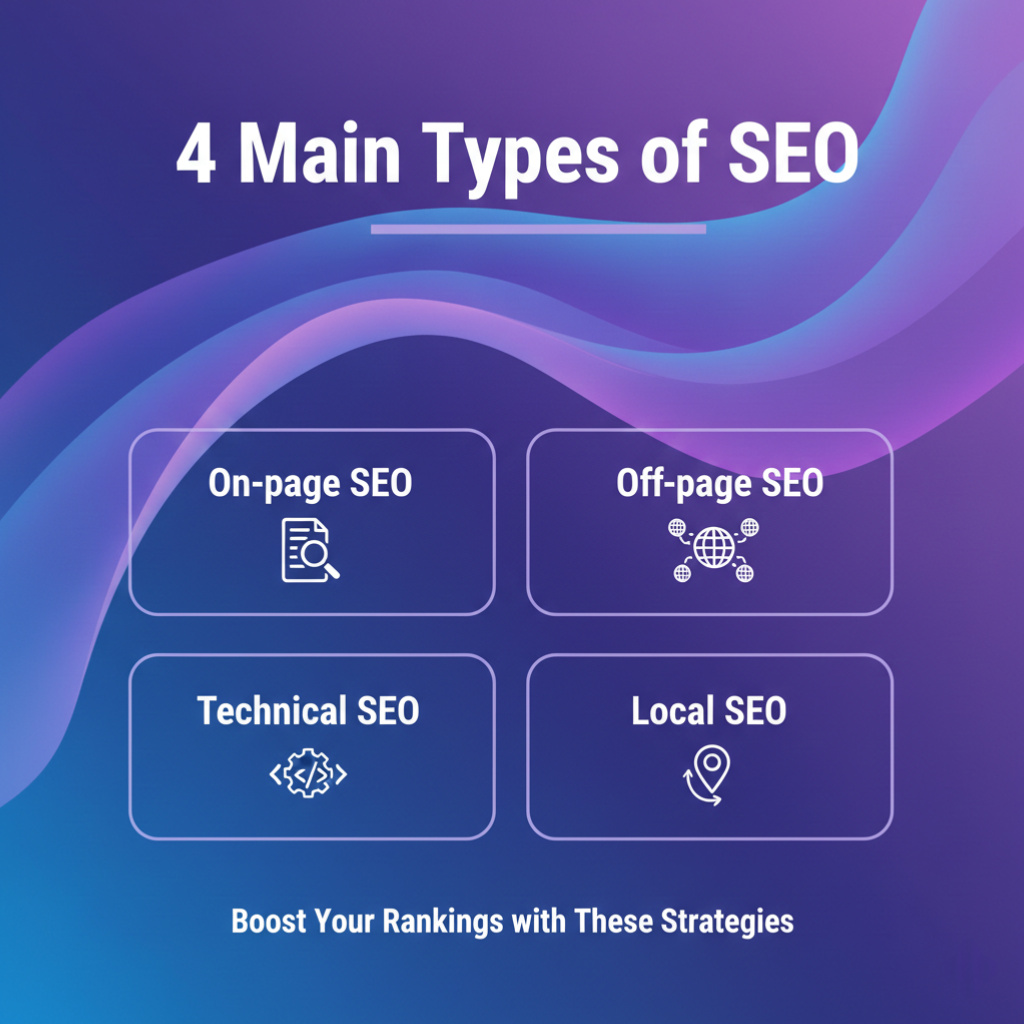
4 Main Types of SEO
To win at SEO, you need to know how the enemy thinks. Search Engines have a job. They store billions of web pages and serve up the best ones when you search.
On-page SEO
This is the stuff you control directly on your website. The words you write. The headers you use. The way you structure your content.
On-page SEO means optimizing your title tags so they actually tell search engines what the page is about. It means writing meta descriptions that make people want to click. It means using header tags (H1, H2, H3) in a way that makes sense, not just throwing them around randomly.
Keywords matter here. Not keyword stuffing – that old tactic of jamming “best shoes New York” into your text fifty times is dead. Google killed it years ago. Now it’s about using relevant terms naturally while actually answering what people want to know.
Off-page SEO
This is mostly about reputation. Link building is the big one. When other trusted sites link to yours, search engines notice. They think “huh, this must be legit.”
But off-page SEO isn’t just links anymore. It’s brand mentions. It’s people talking about you on Reddit or Quora. It’s getting reviewed positively. It’s showing up places where your audience hangs out.
According to our analysts, off-page signals now account for a huge chunk of what makes sites rank. You can have perfect on-page SEO, but if nobody links to you or talks about you, you’ll struggle.
Technical SEO
This is what happens behind the scenes: the code, the architecture.
Technical SEO makes sure search engines can actually find and understand your site. Can they crawl it properly? Does your JavaScript load in a way they can process? Is your site fast? Like, actually fast, not just “eh, it loads eventually” fast.
Core Web Vitals fall here. Those are Google’s specific measurements for page speed and stability. If your site takes forever to load or jumps around while rendering, users hate it. Search engines notice that.
Mobile-first indexing is another piece. Google mostly uses the mobile version of your site for ranking now. If your desktop site looks amazing but your mobile site is garbage, you’re in trouble.
Local SEO
This one’s different. Local SEO is for businesses that actually have a physical location or serve specific areas.
You know when you search “pizza near me” and Google shows a map with three results? That’s Local SEO in action. It’s about optimizing for location-based searches. Getting your Google Business Profile right. Managing reviews. Making sure your name, address, and phone number are consistent everywhere online.
A local bakery needs Local SEO. An international software company? Maybe less so, unless they’re running local events.
SEO Specializations: A Classification
Not all SEO work looks the same. Different contexts require different approaches, and understanding which specialization applies to your situation is part of building a real strategy. Here is how the main specializations break down.
Ecommerce SEO
Ecommerce SEO targets product and category pages, faceted navigation, structured data for products, and the buying intent queries that drive purchase decisions. The challenge here is scale: large catalogs create thousands of pages that can cannibalize each other or generate duplicate content.
Enterprise SEO
Enterprise SEO applies to large organizations with complex sites, multiple stakeholders, and significant technical debt. Coordination between SEO, development, legal, and content teams becomes as important as any individual tactic.
International SEO
International SEO is for businesses targeting audiences in multiple countries or languages. It requires a clear strategy around multilingual content, regional site structure, and global search engines beyond Google. We cover this in depth in its own section below.
Local SEO
Local SEO focuses on location-based searches and map pack visibility. It is covered above and applies to any business serving a defined geographic area.
News SEO
News SEO is built around speed. Google News and Discover reward publishers who get indexed fast, use clear article structured data, and build enough authority to appear in Top Stories. Timeliness and headline clarity matter more here than in almost any other specialization.
How Do Search Engines Work?
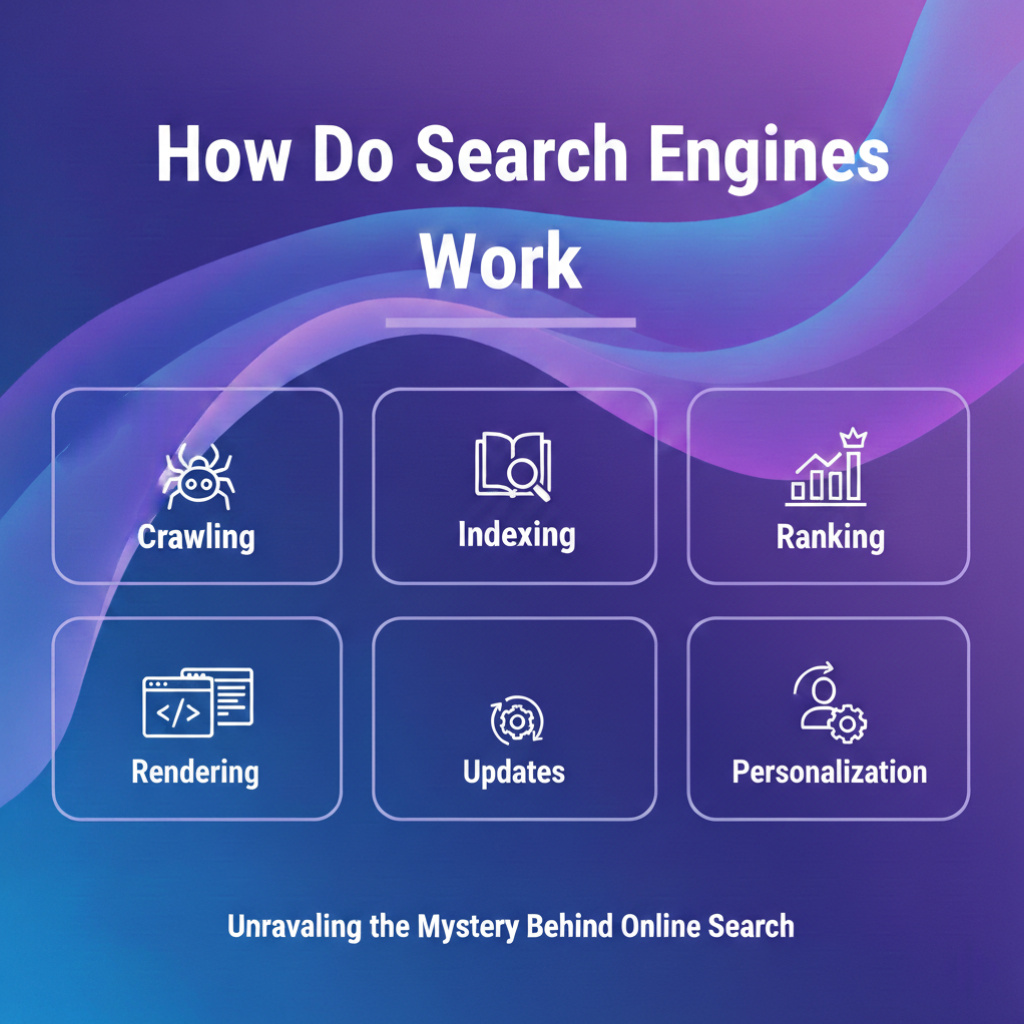
To master SEO, you need to understand the machine. Search engines go through four distinct stages when processing any page on the web: crawling, rendering, indexing, and ranking. Understanding this pipeline helps you diagnose why a page might be invisible even when the content is strong.
Crawling
Search engines send out programs called crawlers. Google’s is Googlebot. These bots follow links across the web, discover pages, read them, and move on.
If your site has broken links or blocks crawlers through your robots.txt file, those pages may never get found. It’s like building a store in the middle of nowhere with no road signs. Crawl budget matters for large sites: if Googlebot spends too much time on low-value pages, important pages may not get crawled frequently enough.
Rendering
After crawling, search engines render the page. This means they process the HTML, CSS, and JavaScript to see what a user would actually see in a browser. Rendering is a separate step from crawling, and it is where many modern sites run into trouble.
If your site relies heavily on JavaScript to load content, the rendered version of a page may look very different from the raw HTML. Search engines have improved at rendering JavaScript, but they do not always do it immediately. There can be a lag between when a page is crawled and when its JavaScript-driven content is processed. For critical content, rendering delays mean ranking delays.
Indexing
Once a page is rendered, the search engine decides whether to add it to its index, which is the database of pages it will consider serving for queries. Not every crawled or rendered page gets indexed. Search engines exclude pages they consider low quality, duplicate, or explicitly blocked through meta tags.
Google Search Console’s indexing report shows exactly which pages have been indexed and which have not, and it explains why excluded pages were left out. This is one of the most useful diagnostic tools available for free.
Ranking
When someone types a query, the search engine searches its index for relevant matches and orders them. Order matters enormously. The first result gets dramatically more clicks than the tenth.
Ranking involves hundreds of signals. Keywords matter. So does site speed. So does whether authoritative sites link to you. So does whether users click your result and stay, or immediately return to search for something else.
Ranking is not a permanent state. Algorithm updates, competitor activity, and changes to user behavior all shift rankings over time. Sites that monitor their positions regularly through tools like Google Search Console can catch drops early and respond before traffic loss compounds.
Constant Updates and Personalization
Search engines never stop. They update algorithms daily. They personalize results based on location and search history. Two people can search the same thing and get different SERPs. Ranking isn’t a trophy you win forever. It’s something you maintain.
Content Optimization
Content optimization is one of the three core pillars of SEO, and it deserves more attention than most beginners give it. It is not simply about writing a lot of words on a page. It is about making sure every element of a page works together to satisfy what the user was looking for when they typed their query.
Content optimization focuses on search intent as its organizing principle. Search intent is the underlying goal behind a query. Someone searching “how to remove a stripped screw” wants instructions, not a product recommendation. Someone searching “best cordless drill under 100 dollars” is comparing options before a purchase decision. Match the wrong content format to the intent and the page will underperform regardless of how well-written it is.
The main elements of content optimization include:
- Headings: Your H1 should clearly state the topic of the page. Subsequent headings (H2, H3) should organize the content logically and reflect the sub-questions a reader is likely to have. Well-structured headings help both users and search engines navigate long pages.
- Metadata: Your title tag is your headline in the search results. It should include your primary keyword and be compelling enough to earn the click. Your meta description is your pitch. It does not directly affect ranking, but it affects click-through rate, which matters.
- Internal links: Linking from one page on your site to another distributes authority, helps crawlers discover content, and guides readers deeper into your site. Every new piece of content should receive links from existing pages that are already indexed and receiving traffic.
- Multimedia: Images, videos, charts, and interactive elements improve the experience for users and can earn additional visibility through image search and video results. Always use descriptive alt text on images so search engines understand what they depict.
- Depth and completeness: A page that thoroughly addresses a topic, including the follow-up questions a reader is likely to have, signals expertise. Thin content that skims the surface tends to rank below content that genuinely covers a subject.
Content optimization is not a one-time task. Pages should be revisited regularly to update statistics, refresh examples, add new internal links, and ensure the content still matches current search intent for the target query.
Brand Authority and Trust
Brand authority is the third pillar of SEO, and it is the one that takes the longest to build. It is also the one that competitors can replicate least quickly, which makes it one of the most durable competitive advantages in search.
Google’s E-E-A-T framework, which stands for Experience, Expertise, Authoritativeness, and Trustworthiness, reflects how the search engine thinks about brand authority. It is not a direct ranking factor in the way that a keyword in a title tag is, but it shapes how Google’s quality systems evaluate whether a site deserves to rank for high-stakes queries, particularly in health, finance, legal, and other sensitive categories.
Brand authority builds through several external signals.
Backlinks
Backlinks are the most established signal. When reputable sites link to yours, search engines interpret it as a vote of confidence. A single link from a well-regarded industry publication carries more weight than dozens of links from low-authority directories. The quality of the sites linking to you matters far more than the quantity.
Brand Mentions
Brand mentions contribute to authority even when they do not include a link. Unlinked references to your company name or product across news sites, forums, review platforms, and social media tell search engines that real people know and talk about you. Monitoring for brand mentions and converting unlinked ones into links where possible is an often-overlooked tactic.
Reviews and reputation signals
Reviews and reputation signals matter especially for local businesses and ecommerce sites. A consistent pattern of positive reviews across Google, Trustpilot, and industry-specific platforms builds the kind of trustworthiness that search engines factor into rankings.
Author Credibility
Author credibility is increasingly important. Content written by identified authors with verifiable credentials and a presence on other authoritative platforms is evaluated more favorably than anonymous content. Author bios with links to credentials, social profiles, and published work help establish this signal.
Brand authority compounds over time. A site that consistently earns mentions, links, and positive engagement across the web becomes progressively easier to rank, because each new piece of content launches from a higher baseline of trust than the last.
Why is SEO Important for Your Website?
Because search is how people find stuff. Period.
When someone needs answers, they go to Google. Or YouTube. Or maybe Amazon if they’re shopping. According to Emarketer 56% of online shoppers start product searches on Amazon. That’s huge.
If you’re not optimized for search, you’re invisible during those moments. Your competitors get the traffic. They get the sales. You get nothing.
SEO builds trust too. People trust Google’s judgment. If you rank high, they assume you’re legit. It’s a credibility shortcut.
And honestly? SEO is sustainable. Paid campaigns stop when you stop paying. Social media algorithms change and your reach tanks overnight. Good SEO work keeps paying off long after you’ve done it.
Why is SEO Essential in the Era of LLMs?
AI is changing everything. Large Language Models (LLMs) like ChatGPT are becoming how lots of people get information. Especially younger users, 51% of Gen Z women now prefer starting searches on TikTok over traditional search engines.
ChatGPT is writing essays. SGE, now often called AI Overviews, is changing how Google displays answers. Is SEO dead?
No. It’s evolving.
LLMs need data. They learn from the web. If your content is well-optimized, it’s more likely to be used as a source. Now we’re even seeing things like Generative Engine Optimization (GEO) , where you optimize for AI tools to cite you.
When Google shows an AI Overviews answer at the top, it still links to sources. You want to be that source. Zero-Click Searches are rising. People get the answer without leaving Google. But you know what? They still remember your brand was the source. It’s about visibility. SEO in the era of AI is about being the authoritative answer, whether the user clicks or not.
Search Intent
Search intent is the reason behind a query. It is the actual goal a person is trying to accomplish when they type words into a search engine, and it is the single most important factor in determining whether a piece of content ranks and converts.
Search engines have become very good at identifying intent. They look at the pattern of results users engage with for a given query and learn from it. This means that if every top-ranking result for a query is a listicle, publishing a long-form essay on the same topic is unlikely to rank well, even if the essay is better written. Format matters as much as content because format is itself a signal of intent.
The four most common intent categories are:
- Informational intent: The user wants to learn something. Queries like “how does photosynthesis work” or “what is a 401k” belong here. The right content format is usually an article, guide, or explainer;
- Navigational intent: The user wants to reach a specific site or page. Queries like “Facebook login” or “Semrush pricing page” belong here. These queries are often won by the brand itself and are less useful for third-party content;
- Commercial investigation intent: The user is researching before a purchase. Queries like “best project management software” or “Mailchimp vs Klaviyo” belong here. Comparison articles, review roundups, and feature breakdowns perform well;
- Transactional intent: The user is ready to act. Queries like “buy noise cancelling headphones” or “sign up for Shopify free trial” belong here. Product pages and landing pages are the right format.
Connecting search intent to keyword research is what separates effective content planning from guesswork. Every keyword you target should be mapped to an intent category before you decide what type of content to create. Matching intent correctly is content optimization’s most foundational step.
E-E-A-T and Brand Signals
Google talks about E-E-A-T. Experience, Expertise, Authoritativeness, Trustworthiness. It’s not technically a ranking factor – more like a framework Google’s quality raters use to evaluate results.
But honestly? It matters. Google wants to surface content from real experts. From people who actually know what they’re talking about.
Brand Authority ties into this. When your brand gets mentioned positively across the web, when people trust you, search engines notice. It’s not just links anymore. It’s your whole reputation.
What are The Three Core Pillars of SEO
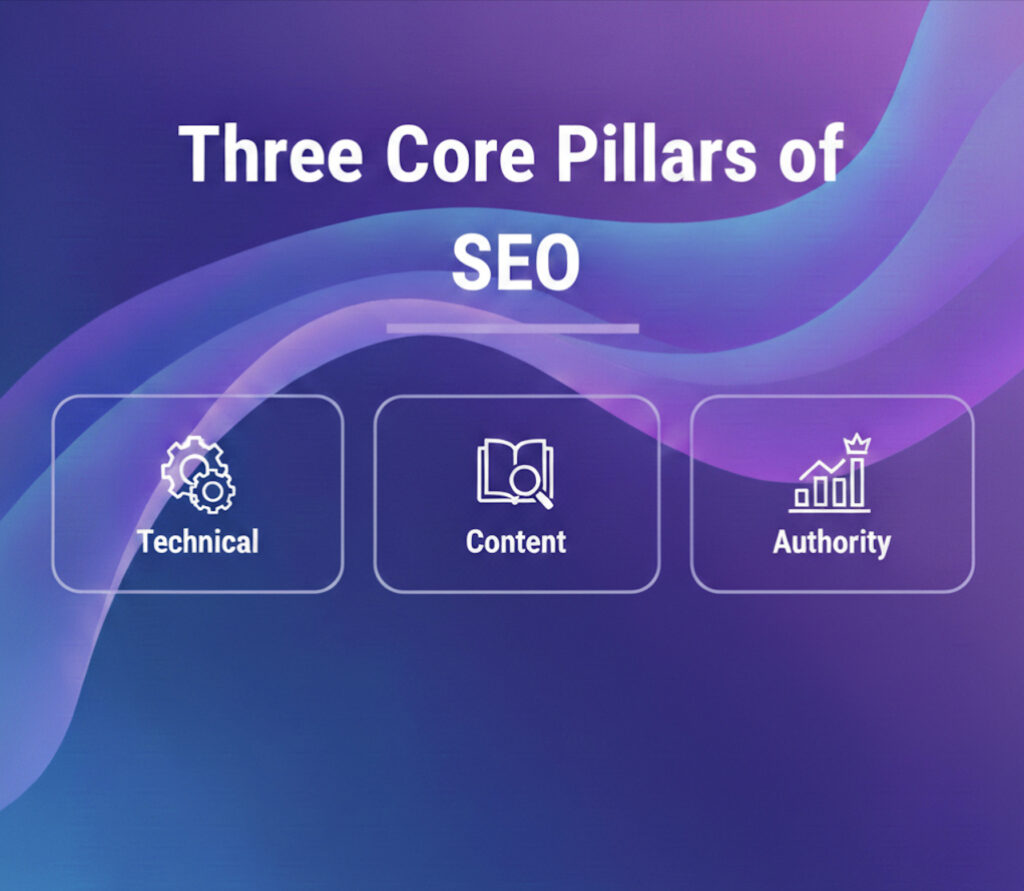
We think about SEO in three buckets, and every specialization and tactic in this guide traces back to one of them.
SEO includes three core components: technical optimization, content optimization, and brand and authority building. Ignore any one of them and the other two underperform.
Technical
Technical optimization covers everything that lets search engines access, render, and understand your site. Crawl infrastructure, page speed, mobile experience, schema markup, and site architecture all live here.
Content
Content optimization is about creating material that satisfies search intent. It covers headings, metadata, internal links, multimedia, and the depth of information you provide on a given topic. Content optimization focuses on search intent above all else: if your page does not match what a user actually wants when they type a query, no amount of technical polish will save it.
Brand and Authority
Brand and authority building is the third pillar. It covers everything that happens off your own site: backlinks, brand mentions, reviews, and the trust signals that tell search engines your content is worth recommending. SEO includes brand and authority building as a distinct branch, not a footnote.
Miss any pillar and your SEO suffers. You can have amazing content nobody can crawl. You can have perfect technical setup with thin, useless content. You can have both but zero links or brand mentions. All three need attention.
What is an SEO strategy?
SEO strategy is your long-term plan. Not just “we want more traffic.” Specific goals. Timelines. Resource allocation.
Maybe you’re targeting Enterprise SEO for a massive multinational site. Maybe you’re doing International SEO with content in multiple languages. Maybe you’re focused on News SEO where speed matters above all else.
A real strategy includes competitor research. It includes understanding your audience’s pain points. It includes setting up proper measurement so you know what’s working.
Without strategy, you’re just guessing. Throwing spaghetti at the wall and hoping something sticks.
How to Do SEO for Beginners?
Start with research. What do people actually search for in your space? Free tools like Google’s Keyword Planner can help. So can the Keyword Research Tool from Semrush.
Then audit your current site. Google Search Console is free and shows you exactly how Google sees your site. Set it up. Look at the data.
Fix technical basics. Make sure your site loads fast. Make sure it works on phones. Make sure Google can crawl it.
Create content that actually helps people. Not content for search engines. Content for humans that answers real questions.
Build relationships. Get mentioned on other sites. Guest post if it makes sense. Engage in communities where your audience hangs out.
Measure everything. Google Analytics is free. Use it. Watch what happens when you make changes.
Common SEO Mistakes Beginners Make
We’ve all made them. Let’s save you the pain. When we first started messing with SEO, we thought it was all about tricking the system. You quickly learn that Search Engines are way smarter than that. They’ve seen every trick in the book. The mistakes usually come from impatience or just not knowing how Ranking actually works.
Beginners often jump in, change twenty things at once, and have no idea what worked. Or worse, they do something shady that gets the whole site slapped with a penalty. It’s frustrating because you put in all this work and see zero movement in the SERPs. Fixing these common errors has a bigger impact on Website Traffic than almost any new fancy tactic.
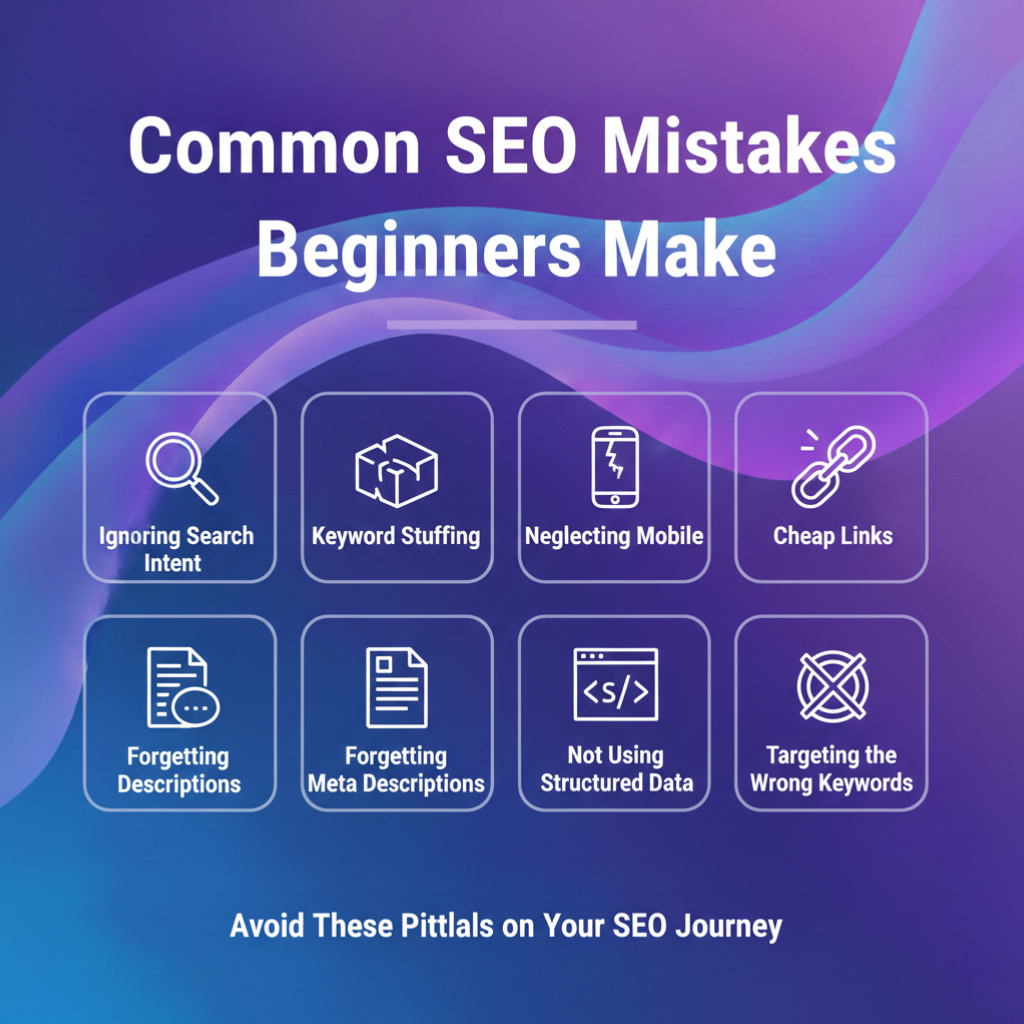
- Ignoring Search Intent – Writing about “best shoes” when people want to buy, not read a history of shoes. You have to match what the user actually wants;
- Keyword Stuffing – Repeating the same phrase awkwardly. It reads terribly and Google penalizes it. Write naturally;
- Neglecting Mobile – Half your traffic is on phones. If it’s broken, they leave. With Mobile-first indexing, Google uses the mobile version of your site for Ranking. If it’s bad, you’re done;
- Buying Cheap Links – This will get you hit by a Google penalty. Avoid it. Real Link Building takes time and relationships;
- Forgetting Meta Descriptions – It’s your free ad in the SERPs (Search Engine Results Pages) . Write something compelling. Get that click;
- Not Using Structured Data – It helps Google understand you and can give you rich snippets. It’s a Technical SEO win that beginners ignore;
- Targeting the Wrong Keywords – Going for broad, high-competition terms instead of specific long-tail phrases. You can’t beat Wikipedia on page one. Go for the niche stuff first.
Honestly, the biggest mistake is thinking SEO is a one-and-done deal. It’s not. You can’t optimize a page in January and forget about it by June. Search Engines update their algorithms constantly. Your competitors are working. Content gets stale. Maybe a new TikTok trend changes how people talk about your topic, and suddenly your Keywords are old news. You have to check your Google Search Console regularly. You have to look at your Google Analytics. See where people drop off. If your UX is clunky, they bounce. And if you’re writing content just for Search Engines and not for humans, the new Helpful Content System will eventually bury you. It’s about building Brand Authority over time, not chasing quick wins.
Key Metrics for SEO
How do you know if your SEO is working? Look at the numbers.
- Organic Traffic: Are more people coming from Search Engines? Check Google Analytics;
- Keyword Rankings: Where do you show up for your main terms? Use tools to track this;
- Click-Through Rate (CTR): Of the people who see you in the SERPs (Search Engine Results Pages) , how many click?;
- Bounce Rate & Dwell Time: Do people stay on your page or leave immediately? User Experience (UX) matters;
- Backlinks: How many new sites are linking to you?;
- Conversions: Ultimately, is this traffic turning into sales or sign-ups?.
How SEO Will Work
AI will be everywhere. SGE and similar technologies will change how results display. Zero-click searches will increase. Fewer people might actually visit websites even when they find information through search.
Voice search will grow. People talk differently than they type. Optimizing for conversational queries matters more.
Video SEO becomes non-negotiable. YouTube is already the second biggest search engine. TikTok is eating into traditional search for younger demographics. Amazon dominates product search.
Personalization gets more sophisticated. Results will vary more based on who’s searching and where.
But fundamentals remain. Good content. Fast sites. Real authority. Those never go out of style.
We think the sites that win will be the ones that adapt without chasing every shiny object. Balance new tactics with timeless principles.
FAQ
Is SEO difficult to learn?
Honestly? It depends. Basic SEO isn’t rocket science. Anyone can learn the fundamentals in a few months. But mastering it? That takes years. The field changes constantly. What worked last year might hurt you this year. So yes and no.
How to learn SEO?
Start with Google’s own resources. Their SEO starter guide is free and accurate. Follow industry blogs. Search Engine Land covers everything. Experiment on your own site. Nothing teaches like doing. Join communities. Reddit has decent SEO forums if you ignore the bad advice. Attend conferences when you can. SMX events are solid.
What skills are needed to become an SEO specialist?
Technical comfort helps. You don’t need to be a programmer, but understanding HTML, CSS, and maybe some JavaScript matters. Analytical thinking is huge. You’ll stare at spreadsheets constantly. Writing skills matter more than most think. Content Optimization is half the job. Patience. SEO takes time and you need to explain that to clients or bosses constantly.
Will AI replace Search Engines?
Maybe eventually. Not soon. Search engines are already incorporating AI. Bing has it. Google has AI Overviews. But people still want options. They still want to click through sometimes. AI answers are useful but not always complete. We think they’ll coexist for a while.
Can AI do SEO?
AI can help. It can generate content ideas. It can help with research. It can spot patterns in data. But fully automated SEO? Not yet. Google’s algorithms are too complex. They actively fight manipulation. AI-generated content without human oversight often fails the Helpful Content System tests. Use AI as a tool, not a replacement.
What free tools should every beginner use?
Google Search Console. Non-negotiable. Google Analytics. Also non-negotiable. Bing Webmaster Tools. Google’s dominant but Bing still drives traffic. AnswerThePublic for content ideas. Ubersuggest for basic keyword research. Google’s PageSpeed Insights for technical checks. That’s enough to start.
How long does it take to see SEO results?
Months. Usually 4-6 for noticeable movement. Sometimes longer for competitive spaces. Sometimes faster if you fix major technical issues on a site Google already trusts. Anyone promising quick results is probably selling something sketchy. SEO is slow and that’s normal.
Is local SEO different from regular SEO?
Yes. Local SEO focuses on “near me” searches and map packs. It requires managing your Google Business Profile. Getting local reviews matters more. Consistent NAP (name, address, phone) across directories is crucial. Regular SEO doesn’t care if your address is listed consistently everywhere. Local SEO absolutely does.
Should I use AI to write my content?
Maybe. Carefully. AI writing tools have gotten good. Really good. But Google wants experience and expertise. AI doesn’t have that. It repackages existing information. For straightforward topics, AI can draft content you then heavily edit and fact-check. For topics requiring real expertise, write it yourself or hire someone who knows their stuff.
What is Google Search Console and why set it up?
Google Search Console is a free tool showing how Google interacts with your site. It shows what keywords you rank for. It alerts you to technical problems. It shows which pages Google can’t crawl. It tells you if you’ve been hit with a manual penalty. Setting it up takes five minutes and gives you data you can’t get anywhere else. Skip it and you’re flying blind.
Related Posts
Ethan Parker
March 19, 2026
6 The Best On-Page SEO Tools and Services For Google Optimization in 2026
Let’s be blunt, you can write the most insightful blog post on the planet, but if your SEO fundamentals are…
Ethan Parker
February 26, 2026
What is Off-Page SEO? Definition, Optimization and Strategies
You’ve built a beautiful website. The content is sharp, the keywords are placed just right, and the pages load faster…
Ethan Parker
March 20, 2026
Off-Page SEO Checklist: Build Authority in 10 Steps
You built a beautiful website. The on-page SEO is tight. Headers flow, keywords sit naturally, and your content beats the…
Ethan Parker
May 21, 2026
How to Do a Full SEO Competitor Analysis: Step-by-Step
Running a SEO competitor analysis isn’t optional if you want organic traffic. It reveals exactly why others outrank you. This…
Ethan Parker
June 25, 2026
10 Content Optimization Strategies to Increase Rankings, Traffic and AI Citations
Most content fails to rank not because it lacks keywords, but because it doesn’t fully answer the reader’s question, or…
Ethan Parker
March 23, 2026
What is Technical SEO? A Complete Guide
What is technical SEO? Ask ten marketers about technical SEO and you will collect ten different definitions. Server logs come…
Ethan Parker
February 23, 2026
61 Types Of SEO (Search Engine Optimization) for 2026
Search engine optimization looks nothing like it did a few years back. AI now sits front and center in almost…
Ethan Parker
February 26, 2026
What is On-Page SEO: Definition, Importance and Optimization
Search keeps flipping upside down these past few years, AI Overview eating clicks, results looking weirder by the month. Yet…
Ethan Parker
April 30, 2026
How Do I Check My Google Ranking For Free?
Putting time or money into Search Engine Optimization without measuring the results of that work does not make much sense.…
Ethan Parker
May 05, 2026
How to Create a Winning SEO Strategy?
SEO has changed and SEO strategy is no longer limited to just keywords. That old playbook is dying and what…