
 Ethan Parker
March 23, 2026
Ethan Parker
March 23, 2026
How to Create a Winning SEO Strategy?
SEO has changed and SEO strategy is no longer limited to just keywords. That old playbook is dying and what…
SEO has changed and SEO strategy is no longer limited to just keywords. That old playbook is dying and what worked two years ago, like mass producing thin content, now gets penalized hard. You need a new map. Maybe one shaped like a pyramid: technical SEO foundation, on-site content, then off-site authority. But watch out, the real game has shifted. AI tools like ChatGPT now answer queries directly, often without sending a single click to your site.
So how do you build a strategy that survives zero click results, adapts to Generative Engine Optimization, and actually brings in qualified leads? We think the answer lives in a few specific approaches. Some are classic but updated. Others, like the avalanche technique or psychographic profiling, flip the old rules completely. Let’s walk through the methods that still work, plus the one thing most guides get wrong about social media’s role.
What is SEO Strategy
An SEO strategy is a comprehensive plan designed to improve a website’s organic search rankings and achieve specific business goals, such as lead generation or increased sales.
A successful strategy is often represented as a pyramid consisting of three layers: technical SEO foundation, on-site content, and off-site authority (digital PR, backlinks, and link building). Modern strategies have evolved beyond just targeting “10 blue links” on Google to include Generative Engine Optimization (GEO), which aims to get a brand recommended by AI tools like ChatGPT and Perplexity.
An SEO strategy includes keyword research as a core component, connecting search demand to the pages and content you create. It also encompasses a keyword map, which is a structured document that assigns specific queries to specific pages based on intent, and a content plan that governs what to create, what to update, and what to prioritize at each stage of execution.
Why SEO Strategy is Important
An effective strategy is crucial because the SEO playbook has changed; traditional methods of mass-producing cheap content are being penalized by Google’s crackdown on AI-generated “thin” content:
- Adapting to the AI Shift: With the rise of AI overviews, many searches result in “zero-click” answers where users find information directly on the search results page. Data shows that 69% of news-related Google searches now end without a click to a website. A strategy ensures your brand is the one being cited by these AI engines as a trusted source;
- Compound Interest: SEO works like compound interest; a consistent strategy builds authority over time, making it easier to rank for previously unavailable competitive keywords;
- Lead Quality: A strategic approach shifts the focus from “traffic for the sake of traffic” to attracting highly qualified leads by aligning content with specific user intent and business goals;
- Visibility Through Technical Health: Technical SEO directly leads to increased search visibility. A site that search engines can crawl, index, and understand outranks technically broken competitors even when content quality is comparable;
- Authority Through Backlinks: Backlinks remain one of the most significant factors in search visibility. Every link from a reputable external site signals to Google that your content is worth ranking. Combined with brand mentions — even unlinked references to your site or company — backlinks form the backbone of off-site authority.
Types of SEO Strategies
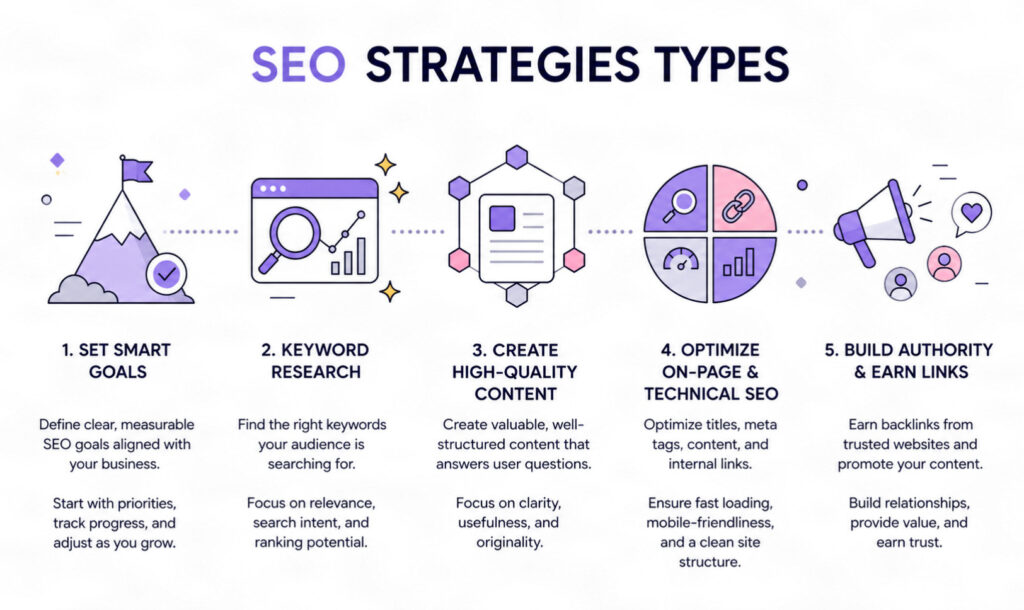
Different businesses need different approaches. A local plumbing company does not compete the same way an ecommerce fashion brand does. Here are the main types of SEO strategies that work right now.
The Avalanche Technique
Instead of going after high volume keywords like “best credit cards” which every finance site wants, you target long tail phrases like “650 credit score credit card approval odds.”
The competition is lower. The traffic comes faster. Once you build authority on those easier terms, you start targeting harder ones. The momentum snowballs. Hence the name.
A finance site might spend six months ranking for specific credit score ranges. After proving their expertise, they can finally rank for “best credit cards.” The avalanche technique requires patience but delivers compounding growth.
Generative Engine Optimization (GEO)
GEO focuses entirely on getting cited by AI models. The structure of your content changes. You lead with a concise summary, almost like an answer box. Then you follow with detailed evidence, data points, and examples. This matching structure makes it easy for AI tools to pull your information.
Content optimized with statistics and quotes showed 30-40% higher visibility in AI-generated responses compared to non-optimized content.
Think of it this way: traditional SEO is focused on people viewing content. GEO is focused on bots extracting data. Both approaches are important, but ignoring GEO in the age of AI means losing significant traffic.
Topic Cluster Strategy
Individual keywords are dying, but the future belongs to topics. You create one long pillar page covering a broad subject like “email marketing.” Then you write cluster pieces on specific subtopics like “email segmentation,” “automation workflows,” and “open rate optimization.”
Every cluster piece links back to the pillar page. Every pillar page links out to the clusters.
This structure tells search engines you are an authority on the whole subject, not just one keyword. It also keeps users on your site longer. They click from the pillar to a cluster, then to another cluster.
Seasonal Strategy
Many businesses ignore seasonality until it is too late. A wedding photographer who starts publishing content in May has already missed proposal season from December through February. A tax accountant who writes about deductions in March has missed the rush.
A winning seasonal strategy plans four content cycles per year. You publish content weeks before the trend starts. This gives Google time to index and rank you before demand peaks.
It also increases your chances of appearing in Google Discover, which can send massive traffic spikes during those high demand months.
Psychographic Profiling Strategy
Demographics tell you how old someone is and where they live. Psychographics tell you what they fear, what they want, and what objections they have.
According to SEO expert Michael Bonfils, using first-party data for psychographic profiling allows you to survey your audience to understand their beliefs and values, rather than just making general assumptions.
Consider two skincare buyers. One is a newcomer who feels overwhelmed by choices. Another is a skeptic who has tried everything and thinks nothing works.
Both are 28-year-old women living in Chicago. But they need completely different content. The newcomer wants simple routines and reassurance. The skeptic wants clinical studies and ingredient breakdowns. Psychographic profiling helps you match tone to mindset.
How to Create an SEO Strategy
Building a strategy from scratch sounds overwhelming. Break it into steps. Follow this order and you will avoid the most common mistakes.
Step One: Define your KPIs and goals
Do not say “I want more traffic.” That’s not a goal, it’s a wish. Say “I want 50 qualified leads per month from organic search” or “I want to increase ecommerce conversions by 20 percent within six months.” Specific numbers give you something to measure against.
Write down your starting point. Current monthly traffic, conversion rate, and ranking positions for your top ten keywords. You cannot know if you are winning unless you know where you began.
Step Two: Fix your technical issues
This step is boring, but crucial. Technical SEO is its own discipline — the infrastructure layer that everything else depends on. Search engine robots and AI agents will abandon your site if they encounter errors such as 404 pages, redirect loops, slow page load times, and broken images. Fixing these issues directly leads to increased crawlability and, in turn, better search visibility.
Perform a technical audit every quarter. Large ecommerce sites with thousands of products might need monthly checks. Use Google Search Console (GSC) to identify technical problems at scale.
Inside GSC, the indexing report shows which pages Google has successfully crawled and indexed, and which have been excluded or flagged with errors — making it your first stop when diagnosing visibility problems.
The Core Web Vitals report measures real-world page experience across metrics like loading speed, interactivity, and layout stability, which Google uses as ranking signals for both desktop and mobile
Implement schema markup. This is structured data that helps search engines understand what your content means. A recipe schema tells Google this is a recipe with cooking time and ingredients. A product schema tells Google this item has a price and availability. AI systems rely on schema to navigate your “filing cabinet” of information.
Step Three: Conduct unique keyword research
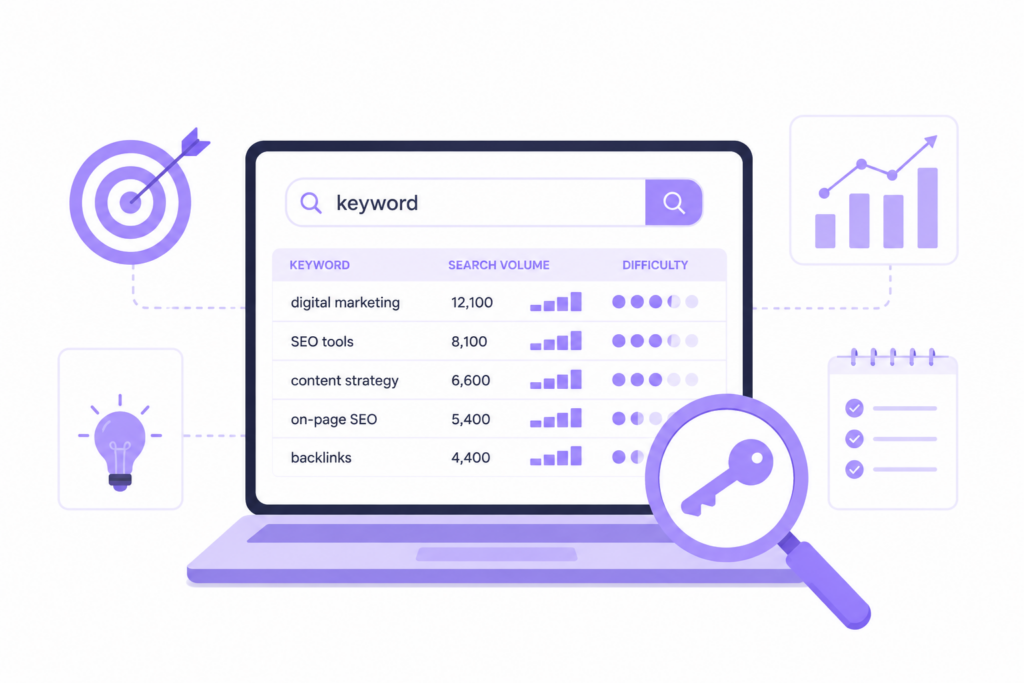
Most people open a keyword tool and grab whatever has high volume. That is a mistake, because high volume also means high competition.
Effective keyword research requires evaluating four dimensions for every term you consider: search intent (what the user actually wants to accomplish), search volume (how often the query is searched per month), keyword difficulty (how competitive the landscape is), and clustering potential (whether the keyword belongs with related terms that can be grouped into a single page or topic cluster).
Search intent deserves particular attention. A query like “how to fix a leaky faucet” signals informational intent — the user wants to learn. “Best faucet brands” signals commercial investigation. “Buy Moen faucet online” signals transactional intent.
Mapping the right intent to the right content type is what separates rankings that convert from rankings that just generate impressions.
Use ChatGPT or other AI tools to generate “seed” keywords. Ask questions like “what questions do people ask before buying a dishwasher?” or “what problems do new runners face?” Then take those seeds into a research tool to check volume and difficulty.
Look for keyword gaps. What are your competitors ranking for that you are not? Can you create something better? More recent? More detailed?
Step Four: Build content plan
Before writing a single word, you need two planning documents that work together.
A keyword map is a structured reference that assigns specific queries to specific pages on your site. Each row connects a target keyword to a URL, specifies the primary search intent that page should satisfy, and notes any secondary keywords the page can support without competing with itself.
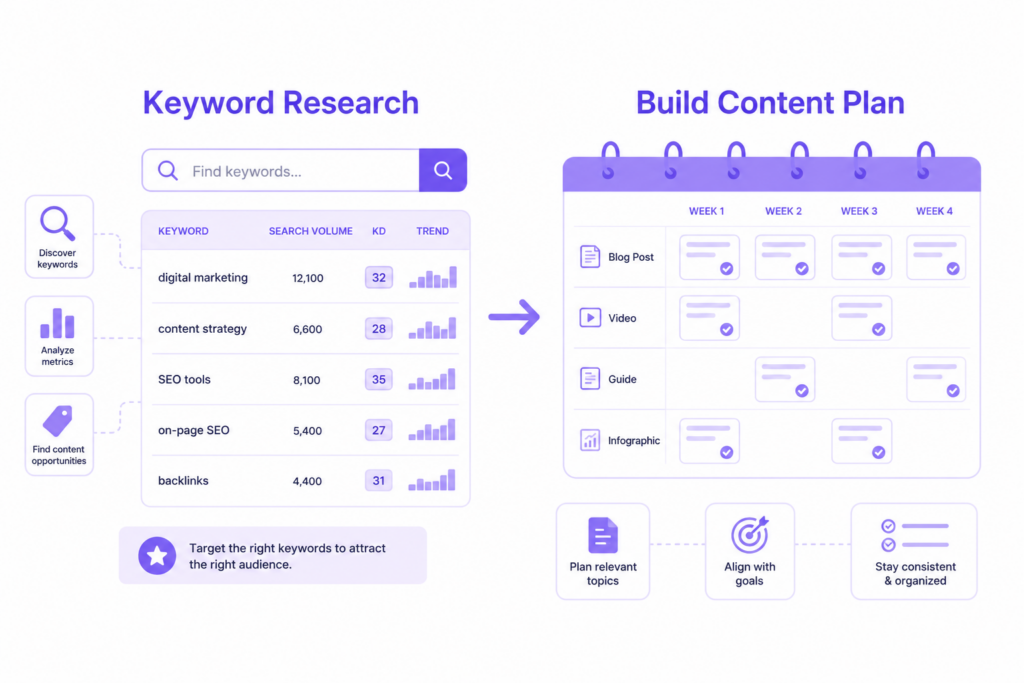
Keyword mapping prevents cannibalization — where two of your own pages compete for the same query — and ensures every page has a clear, distinct purpose in the eyes of search engines. When a keyword lacks a home, the map tells you a new page needs to be created.
A content plan translates your keyword map into an actionable editorial schedule. It answers three questions: what to create (new pages targeting unaddressed queries), what to update (existing pages that rank on page two or have outdated information), and what to prioritize (which items will have the biggest impact on goals, given current resources).
A well-structured content plan organizes work by quarter, assigns owners, and tags each piece with its target keyword cluster and funnel stage.
Every piece of content needs a job. Some pieces attract new visitors, some convert existing visitors into leads, some keep people on your site longer.
Map each article to a stage of the customer buying journey — awareness, consideration, or decision — and match your tone and depth to where the reader is in that journey.
The internal linking secret that speeds up ranking is simple. Find three old pieces of content on your site that are already indexed and getting traffic. Add descriptive links from those old pages to your brand new post. This shares existing authority with the new page. A/B tests have shown that boosting internal links to priority pages can increase organic traffic by 8–47%.
Structure your content for both humans and AI. Add a concise summary at the top for AI extraction.
Step Five: Develop off site authority
On-site content gets you in the game, but off-site authority helps you win. Google and AI tools look at who is talking about you, and that signal comes from three distinct sources: backlinks, brand mentions, and link building outreach.
Backlinks — links from other websites pointing to yours — remain the most powerful off-site ranking factor. Each backlink from a reputable domain acts as a vote of confidence that increases your search visibility.
Not all links are equal: a single mention from a high-authority trade publication outweighs dozens of links from low-quality directories.
Brand mentions matter even when they don’t include a hyperlink. Unlinked mentions of your company name, product, or domain across news sites, forums, and social platforms contribute to Google’s understanding of your authority and trustworthiness. Monitoring for these mentions and, where appropriate, requesting that editors convert them into links is an often-overlooked tactic.
Link building through digital PR works well here: conducting an original survey and publishing the results, starting a petition related to your industry, or creating a tool or calculator that other sites want to link to.
Manual outreach still matters too. Find websites that link to your competitors and explain why your content is better or more current. Some will switch their link to you.
Step Six: Maintain consistency
SEO rewards patience and punishes bursts of activity followed by silence. But consistency without measurement is just motion. Both matter equally.
Tracking and auditing should run on a defined cycle. Use Google Search Console as your primary measurement tool: the indexing report tells you how much of your site Google can see, while the Core Web Vitals report tracks the performance signals that affect rankings directly.
Beyond GSC, monitor key performance metrics including organic traffic, keyword ranking positions, click-through rates, conversion rate from organic, and the ratio of indexed pages to total published pages.
Run a full technical SEO audit every quarter. During each audit, check for 404 error pages and redirect loops, verify Core Web Vitals scores on mobile and desktop, test all forms and checkout flows, review your XML sitemap for orphaned pages, update outdated statistics and date references, check for broken internal and external links and confirm your robots.txt file is not accidentally blocking important pages.
A weekly publishing schedule beats a monthly binge. Search engines notice patterns. A site that adds value every week looks more reliable than a site that posts twelve articles in one day and nothing for eleven months.
Apply the same internal linking pattern to every new piece, follow the same promotion routine on social channels, and run the same review cycle for updating older content monthly so nothing goes stale.
How to Incorporate Social Media Into SEO Strategy
To incorporate social media into an SEO strategy, you don’t need a hundred tools. Just a few smart moves.
Here’s what works, according to our analysts:
- Optimize your social profiles for search: Use relevant keywords in your bio, headline, and “about” section. That’s low effort, high reward;
- Share content people actually click: Social signals aren’t a direct ranking factor. But more clicks mean more traffic, longer dwell time, and sometimes backlinks;
- Use hashtags like a filing system: They help platforms categorize your posts. Google can crawl public profiles, so strategic tags boost discoverability;
- Encourage shares from real users: Genuine engagement creates a ripple effect — more brand searches, then more organic clicks;
- Repurpose high-performing social posts into blog content or FAQs: This builds internal links and keeps your site fresh;
- Add social sharing buttons but don’t beg: One ugly popup kills trust. Simple placement near the headline works better.
Track referral traffic from each platform monthly. Adjust fast. Short cycles beat perfect plans.
Top 12 SEO Strategies
Here is the complete final list of strategies that form a winning SEO playbook for the years beyond. Each one deserves dedicated attention in your planning process.
1. The Avalanche Technique
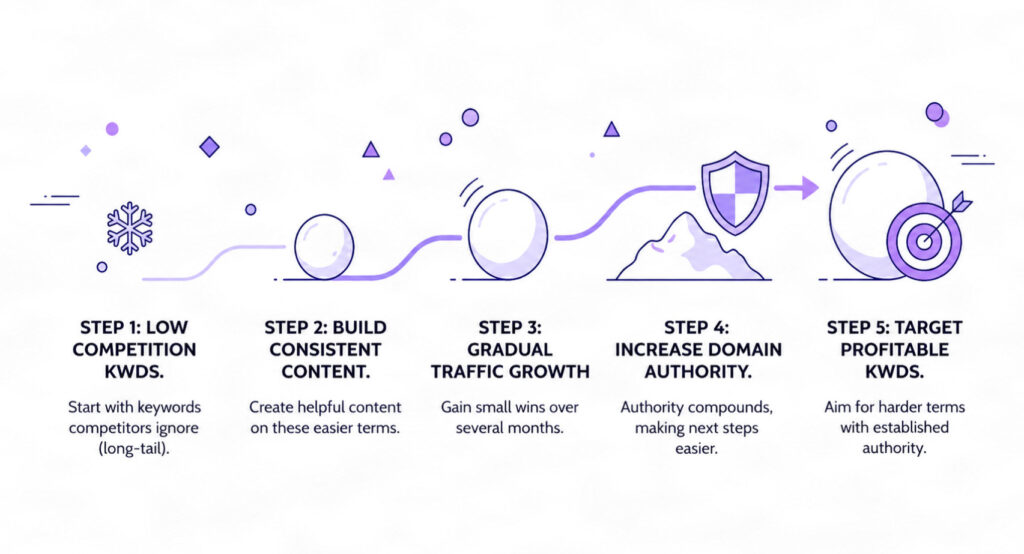
Start with low competition long tail keywords that established competitors ignore completely. Build traffic and domain authority gradually on those easier terms over several months. Then target harder, more profitable keywords as your authority grows. This compounding growth approach wins over time without requiring massive budgets.
You should use this strategy when you are a new website with zero existing domain authority, when your industry is dominated by established competitors with strong backlink profiles, when you have limited budget for paid ads or link acquisition, and when you need to show some results within three to six months.
2. Generative Engine Optimization (GEO)
Structure every piece of content with concise summary paragraphs followed by detailed supporting evidence. This mirrors AI response patterns and increases your chances of being cited by ChatGPT, Perplexity, and Google AI Overviews significantly compared to traditional formatting.
Research by Superlines confirms that adding citations, quotations, and statistics can boost AI visibility by up to 30-40%.
Key actions for GEO implementation: add a two to three sentence summary box at the top of every article, use bullet points and numbered lists for extractable information, include data with specific numbers and publication dates, structure headings in a clear logical hierarchy, and answer follow-up questions immediately after main points.
3. Topic Clusters with Pillar Pages
Stop targeting individual keywords in isolation. Cover entire subject areas comprehensively. Create one pillar page covering a broad topic and multiple supporting cluster pieces that all link back to the pillar for topical authority.
A complete example cluster for “coffee brewing” would have a pillar page called “Complete Guide to Coffee Brewing,” with cluster articles covering French press troubleshooting, pour over technique for beginners, espresso temperature and pressure settings, cold brew ratios and steeping times, and grind size recommendations for each brewing method.
4. Quarterly SEO Audit
Your quarterly audit checklist should include: running Google Search Console for indexing reports, checking Core Web Vitals scores on both mobile and desktop, testing all forms and checkout processes, reviewing your XML sitemap for missing or orphaned pages, updating copyright dates and year references, removing or updating outdated statistics, checking for broken internal and external links, and verifying that your robots.txt file is not blocking important pages.
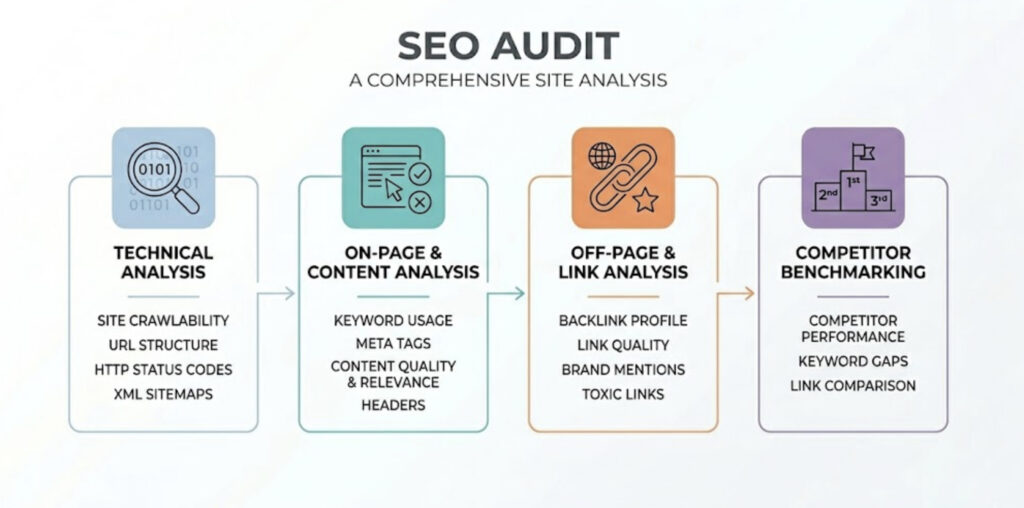
Conduct a full technical SEO audit every three months. These audits improve crawlability, surface indexing errors early, and directly lead to increased visibility over time.
5. The Internal Linking System
For every new piece of content you publish, find three old indexed posts on related topics. Add descriptive anchor text links from those authority pages to your new post. This shares existing PageRank and speeds up ranking compared to waiting for natural discovery.
To find your three old pages, search your own site for the main keyword of your new post. Pick three pages that already rank well for related terms. Ensure each link feels natural within the existing content. Use descriptive anchor text that includes your target keyword so search engines understand the relationship.
6. Seasonal Content Momentum
Plan four distinct content cycles per year aligned with your business seasons. Publish seasonal content weeks before each trend begins gaining search volume. Capture the Google Discover traffic spike during peak demand months.
The seasonal planning template: ten weeks before peak, identify seasonal keywords from prior year data; eight weeks before, build your content calendar; six weeks before, begin publishing on a weekly schedule; four weeks before, share across social and email; during peak, monitor rankings and gather data for next year.
7. Psychographic Audience Profiling
Target specific motivations, fears, and objections instead of broad demographic categories. Create different content for different mindsets within the same demographic group. Match your tone, examples, and proof points to each distinct reader persona.
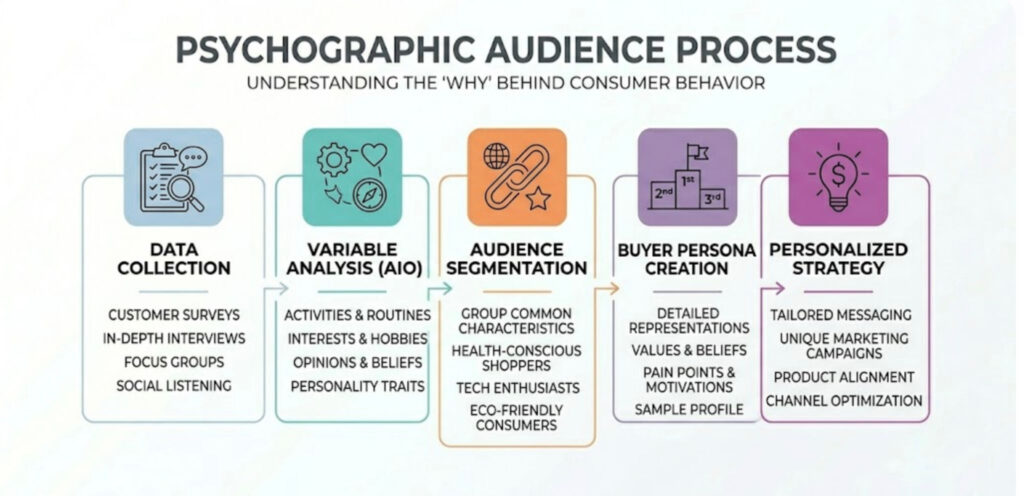
Common psychographic profiles include: the price-focused buyer who wants comparisons and cost breakdowns; the quality-focused buyer who wants materials information and longevity data.
The anxious first-timer who wants step-by-step guidance; the time-constrained buyer who wants efficiency above all; and the skeptical researcher who wants data, studies, and third-party validation.
8. First Party Experience Signals
Pack your content with original videos, photographs, and first-person insights. Prove through your content that your team has actual hands-on experience with the topic. Generic information that fifty other sites already published no longer ranks well.
Google’s E-E-A-T framework (Experience, Expertise, Authoritativeness, Trustworthiness) specifically rewards demonstrable first-hand experience.
Ways to demonstrate this include recording real-condition product videos, taking original photographs instead of stock images, sharing mistakes and lessons learned, adding author bios with credentials, and including customer photos and testimonials.
9. Digital PR and Original Research
Conduct surveys of your customers and publish the unique findings. Create original data sets that do not exist anywhere else. Earn mentions through genuine newsworthiness — both linked backlinks and unlinked brand mentions contribute to your off-site authority profile.
Digital PR tactics by effectiveness: original surveys (high effort, very high return); free tools or calculators (high effort, high return); expert commentary on breaking news (medium effort, medium return); guest posting on industry sites (medium effort, medium return); infographics with unique data (medium effort, medium return); charity partnership announcements (low effort, low to medium return).
10. Zero Click Optimization
Optimize your content specifically for featured snippets and AI Overviews that appear above regular search results. Accept that many users will not click through to your site at all. Those citations still build brand recognition and future direct traffic when users remember your name later. According to SimilarWeb, click-through rates have increased from 56% to 69% since the launch of AI-powered summaries, and when AI-powered summaries are present, users only click on links in traditional search results 8% of the time.
Your zero click optimization checklist should include answering the main question directly within the first one hundred words of your article. Use a definition format like “X is Y that does Z” to target featured snippets specifically.
Structure lists as proper HTML list tags rather than just typing hyphens manually. Keep answers brief, aiming for forty to sixty words for paragraph style snippets. Add a table when comparing multiple options or products, though AI can extract from well structured lists as well. Include a “summary” heading right before your concise answer so crawlers know where to look.
11. Query Fan Out Coverage
Anticipate the hundreds of sub queries that an AI tool will generate from one single user question. Create content that answers all of those tangential questions through related topic clusters. Cover the main topic and every related subtopic that curious readers might want to explore further.
An example of a query fan out for “how to start a podcast” shows how this works in practice. The main query generates sub queries about what microphone to buy, how to edit audio for free, where to host podcast files, how to get guests for the show, and how to submit to Apple Podcasts.
For each sub query, you need related content such as a microphone buying guide, a free editing software tutorial, a podcast hosting comparison chart, guest outreach email templates, and a platform submission walk through for each directory.
12. Consistency Over Intensity
Publish content weekly on a predictable schedule rather than in unpredictable bursts. Show search engines that you are a reliable, ongoing source of value in your industry. Patience and steady consistency beat short term fireworks every single time when measured across twelve months.
What consistency looks like in practice means using the same publishing day each week so Google starts to expect your updates on that schedule. Maintaining the same content length range per post so readers know what to expect from each article.
Applying the same internal linking pattern to every new piece you publish. Following the same promotion routine across your social media channels for each article. Running the same review cycle for updating older content on a monthly basis so nothing gets stale.
Related Posts
Ethan Parker
March 23, 2026
What is Technical SEO? A Complete Guide
What is technical SEO? Ask ten marketers about technical SEO and you will collect ten different definitions. Server logs come…
Ethan Parker
February 23, 2026
61 Types Of SEO (Search Engine Optimization) for 2026
Search engine optimization looks nothing like it did a few years back. AI now sits front and center in almost…
Ethan Parker
June 25, 2026
10 Content Optimization Strategies to Increase Rankings, Traffic and AI Citations
Most content fails to rank not because it lacks keywords, but because it doesn’t fully answer the reader’s question, or…
Ethan Parker
April 30, 2026
How Do I Check My Google Ranking For Free?
Putting time or money into Search Engine Optimization without measuring the results of that work does not make much sense.…
Ethan Parker
May 21, 2026
How to Do a Full SEO Competitor Analysis: Step-by-Step
Running a SEO competitor analysis isn’t optional if you want organic traffic. It reveals exactly why others outrank you. This…
Ethan Parker
May 22, 2026
10 Actionable SEO Tips to Boost Your Rankings and LLM Visibility
Getting SEO advice from random blogs wastes your time. Real SEO requires tactics that work for both Google algorithms and…
Ethan Parker
January 23, 2026
What is SEO? A Beginner’s Guide to Search Engine Optimization
What is SEO? SEO stands for Search Engine Optimization. It’s the thing you do when you want Google or Bing…
Ethan Parker
February 26, 2026
What is On-Page SEO: Definition, Importance and Optimization
Search keeps flipping upside down these past few years, AI Overview eating clicks, results looking weirder by the month. Yet…
Ethan Parker
March 19, 2026
10 Common Technical SEO Issues Killing Your Rankings (And How to Fix Them)
SEO issues often lurk quietly in most websites. They silently sabotage your Google rankings without any warning. One overlooked server…
Ethan Parker
March 19, 2026
6 The Best On-Page SEO Tools and Services For Google Optimization in 2026
Let’s be blunt, you can write the most insightful blog post on the planet, but if your SEO fundamentals are…