
 Ethan Parker
March 24, 2026
Ethan Parker
March 24, 2026
What is Paid Media? Definition, Benefits, Tactics and Examples
You’ve seen it a thousand times. The sponsored post that stops your scroll. The text ad is sitting pretty at…
You’ve seen it a thousand times. The sponsored post that stops your scroll. The text ad is sitting pretty at the top of Google search results. That’s paid media in action. It is the oldest trick in the marketing playbook, but also the most technically complex. Simply put, it refers to any form of advertising where you pay for placement. You are renting attention. Unlike a blog post on your own site, which sits there waiting to be found, paid media forces the issue. It injects your message directly into the path of a potential customer. It’s fast. It’s measurable. And if you ignore it, you are basically hoping your audience stumbles upon you by accident. In a market where algorithms change overnight, understanding this space isn’t just helpful; it’s survival.
What is Paid Media
Let’s cut through the jargon. Paid media is the acquisition of traffic or visibility through financial investment. You pay a platform — Google, Meta, a niche publisher — to display your content to a specific audience. Transactional. You bring the budget. They bring eyeballs.
But there’s more to it than buying ads. Modern paid media includes complex bidding strategies, audience segmentation, and creative testing. It’s no longer just buying a banner on a website. Today it’s a discipline that demands constant optimization. Today it’s a discipline that demands constant PPC optimization and fine-tuning. You bid against competitors in real time. Every second, algorithms decide if your ad is relevant enough to show. Or if it gets tossed into the digital abyss.
We think of it as the accelerator pedal for business growth. If your organic presence is a slow climb up a mountain, paid media is the helicopter. Gets you to the top instantly. Fuel costs money. The definition has shifted from “buying space” to “buying attention with intent.” It lets a brand bypass the slow build of SEO or the uncertainty of viral trends. You want results next week? Run a campaign today.
Paid Media Short Definition
Paid media is advertising you pay for, plain and simple. You rent space, buy clicks, or sponsor posts to put your message in front of someone else’s audience. It is transactional. Fast. Measurable.
Paid Media Types and Examples
The ecosystem is massive. To understand it, you need to see the different flavors. Here are the primary types with concrete examples.
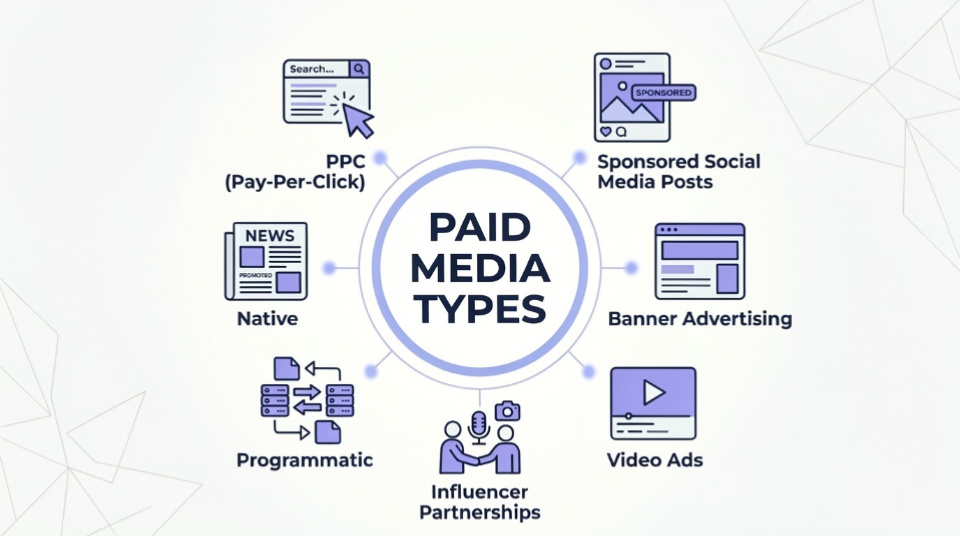
Pay-Per-Click (PPC) Advertising
This is the heavyweight champion. PPC means you only pay when someone clicks. If they just look and move on? Costs you nothing. The dominant player here is Google Ads. Imagine you sell custom hiking boots. You bid on the keyword “waterproof leather hiking boots.” Someone searches for that exact phrase. Your ad appears. They click. You pay a few dollars—or cents, depending on competition. They land on your site.
Sponsored Social Media Posts
Social platforms turned into pay to play arenas. Organic reach on Facebook and Instagram? Almost nothing.
Sponsored social media posts fix that. A clothing brand pays to boost a reel showing off a new jacket. Targeting: women, 25 to 40, interested in snowboarding, living in Colorado. On LinkedIn, a B2B software company pays to show a white paper to IT directors in the finance sector.
These ads blend into the feed. Distinctly labeled “Sponsored,” but they blend.
Display Advertising (Banner Advertising)
These are the visual ads you see on websites. Display advertising (or banner advertising) can be static images, GIFs, or even interactive mini-games. They are often used for brand awareness. A car manufacturer might buy display advertising slots on a major news site. If you visited a car dealership website yesterday, you might see those same cars following you around the internet today. That’s a subset called retargeting.
Video Ads
Video ads? A picture might be worth a thousand words, but a video racks up a million clicks.
These things own YouTube, TikTok, connected TV. You’ve got skippable in-stream—the ones you bounce from after five seconds. Bumper ads, those quick six-second spots you can’t skip. Then in-feed video ads that just look like organic TikToks.
Our data shows higher engagement with video. Simple reason: audio, motion, emotion all hit at once.
Influencer Partnerships
You can’t buy trust outright. But you can rent it.
Influencer partnerships work like this: pay someone with a loyal following to promote your product. We’re not just talking about celebrities. A micro-influencer with 10,000 dedicated cooking enthusiasts? That person can drive more sales for a kitchen gadget than a billboard in Times Square.
This is paid media. A direct transaction for access to that influencer’s audience.
Programmatic and Native
Behind the scenes, much of this is automated. Programmatic ads use AI to buy ad space in milliseconds. Then there is native content—ads designed to look and feel like the editorial content around them. A sponsored article on a magazine site that reads like a normal story but says “sponsored” at the top is native.
Earned Media vs. Owned Media vs. Shared media
You cannot build a strategy on paid media alone. It exists in a triangle with two other forces: earned media and owned media. Understanding the difference keeps your budget from being wasted.
Owned media is your territory. Your website, your blog, your email list, your Instagram profile. You control it completely. If the algorithm changes, your email list doesn’t disappear. However, owned media has a reach problem. If you build it, they will not come unless you tell them to come. That’s where paid media steps in. You pay to drive traffic to your owned assets.
Earned media is the wild card. This is publicity you didn’t pay for directly. A journalist writes about your startup. A customer shares a photo of your product with their 10,000 followers. It’s word of mouth at scale. You can’t buy earned media, but you can facilitate it. Smart marketers use paid media to amplify earned media. If a magazine writes a great review, you run sponsored social media posts linking to that review. It’s a symbiotic relationship.
Then there is shared media. This is often lumped in with earned, but it’s distinct. Shared media refers to organic social sharing. It’s the retweet, the share, the repost. It’s how your message spreads through networks. Paid media often acts as the spark that ignites shared media. A boosted post gets visibility, which prompts real users to share it with their friends, generating organic amplification.
Here is the table formatted for easy copying into Google Docs. You can simply select it, copy (Ctrl+C or Cmd+C), and paste (Ctrl+V or Cmd+V) directly into your document. The formatting should transfer cleanly.
Comparison Table Between Earned Media and Owned Media and Shared media
| Media Type | Definition | Key Examples | Control Level | How Paid Media Interacts |
|---|---|---|---|---|
| Owned Media | Your brand-controlled channels and assets. You have full authority over the content and user experience. | Website, blog, email list, Instagram profile, mobile app. | Full control. The algorithm cannot delete your email list, but reach is limited. | Paid media drives traffic to these assets, solving the “if you build it, they won’t come” problem. |
| Earned Media | Publicity gained through organic efforts and third-party validation. It is “word of mouth at scale” that cannot be bought directly. | Journalist articles, customer reviews, press mentions, unsolicited influencer coverage. | No control. You cannot dictate what is said or when it appears. | Smart marketers use paid media to amplify earned media (e.g., boosting a sponsored post that links to a positive magazine review). |
| Shared Media | Organic distribution driven by audience networks. It is distinct from earned media, focusing on the act of passing content along. | Retweets, shares, reposts, user-generated content shares. | Indirect influence. You control the content, but not the user’s decision to share it. | Paid media acts as the spark. A boosted post gets visibility, prompting real users to share it with their friends, generating organic amplification. |
What are The Core Benefits of Paid Media
Why allocate a budget here? The benefits go beyond just “getting seen.”
- Immediate Results: SEO takes months. Content marketing takes patience. Paid media works in real time. You can launch a campaign at 9:00 AM and have sales by 9:15 AM. For product launches, seasonal spikes, or urgent inventory clearance, nothing else moves this fast;
- Precision Targeting: The granularity is scary good. You aren’t just targeting “men.” You are targeting “men who have recently searched for luxury watches, earn over $150,000, and live within 5 miles of your store.” Audience targeting using demographics, interests, and behaviors allows you to put your message in front of the exact person most likely to convert;
- Measurable ROI: Traditional advertising (billboards, TV) was a gamble. With digital paid media, you see the math. ROI / measurable results are baked into the platforms. You can track click-through rate, cost per click (CPC), cost per mile (CPM), and return on ad spend. If a keyword isn’t working, you pause it. If an image isn’t getting clicks, you swap it out. There is no guessing;
- Scalability: Found a strategy that works? You can pour fuel on the fire. If your PPC campaign is generating a 5x return, you can increase the budget instantly. Paid media scales vertically and horizontally. You can take a successful campaign from one city and replicate it across fifty states.
Key Paid Media Channels and Platforms
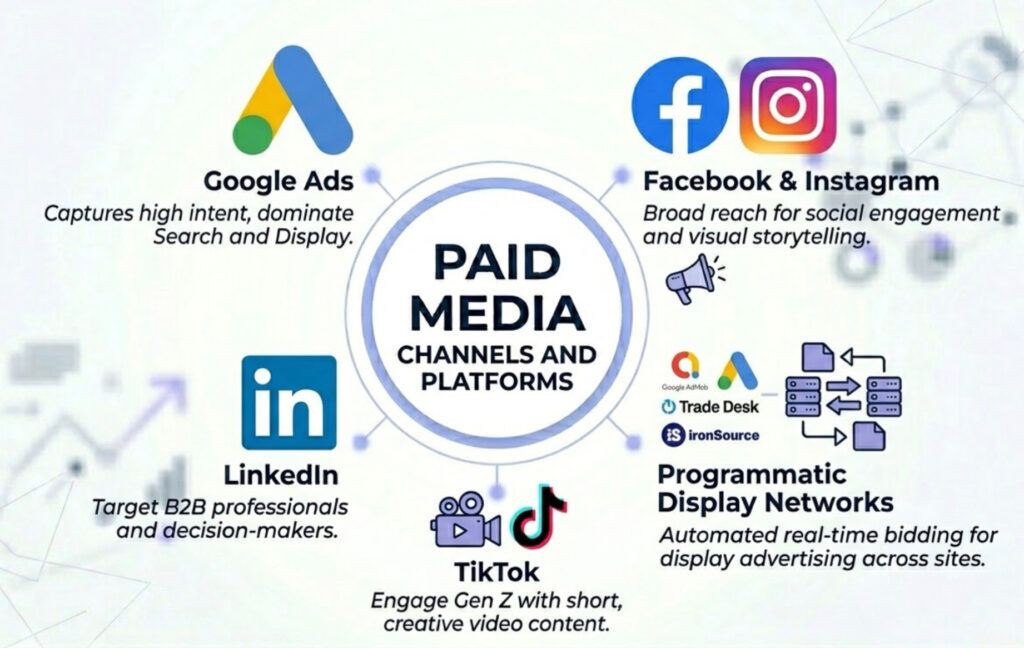
Not all channels are created equal. Choosing the right one depends entirely on your goal and audience. If you want to understand how to choose paid media channels, you have to look past the hype and look at user behavior. What are they doing when they see your ad? That dictates the platform.
Google Ads
This is the king of intent.
Google Ads captures people actively searching for a solution. Someone types “plumber near me”? They need a plumber now. Google Ads — Search, Display, Shopping — dominates the PPC landscape. Performance marketers usually stop here first. The conversion intent runs higher than social media.
Meta (Facebook & Instagram)
These platforms excel at discovery.
Users aren’t searching for your product. They are scrolling to be entertained. Sponsored social media posts interrupt the scroll. Facebook offers powerful audience targeting based on life events. Newly engaged. Moved to a new city. Instagram is visual first. Perfect for fashion, food, and lifestyle brands.
If you sell to businesses, you are here.
LinkedIn is expensive. Cost per click runs significantly higher than Meta. But the targeting for B2B? Unmatched. You can target by job title. Seniority. Company size. Even specific industries.
TikTok
Short-form video ads dominate here.The algorithm is aggressive. TikTok ads require a native feel. Polished TV commercials often fail. Best for brands trying to reach Gen Z or Millennials with humor and authenticity.
Programmatic Display Networks
These networks use programmatic ads to buy inventory across millions of websites. It’s not one platform but an ecosystem. It allows for massive scale for display advertising and retargeting campaigns.
How Does Paid Media Increase Organic Traffic
This is a question we hear constantly. Why spend money on ads if your goal is to rank higher in Google? The connection is indirect but powerful.
- First, paid media drives traffic to your owned media. When you run PPC campaigns to a blog post or a tool on your site, you increase the volume of visitors. Google’s algorithms notice this. If a page receives high-quality traffic from ads and users stay on the page (low bounce rate), it signals that the page is valuable. Over time, this boosts the organic ranking of that page. It’s a signal boost;
- Second, there is the link-building factor. Sponsored social media posts and influencer partnerships often lead to earned media. When an influencer shares your product, journalists and bloggers see it. They may link to your site from their publications without you asking. Those backlinks are the fuel for SEO. According to our analysts, campaigns that combine paid media with high-quality content see a 30% faster growth in organic keyword rankings compared to those relying solely on SEO;
- Third, retargeting keeps your brand top-of-mind. Someone might discover you organically, leave, and then see a video ad later. They return directly—typing your URL into the browser. Direct traffic is a strong ranking factor for search engines.
4 Basic Paid Media Tactics
If you are new to this, don’t try to boil the ocean. Start with these foundational tactics.
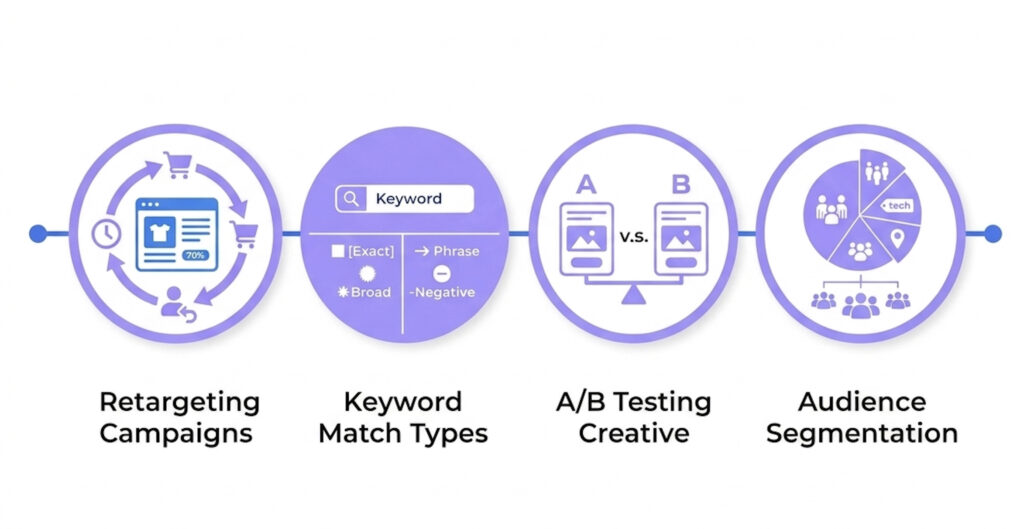
- Retargeting Campaigns — The majority of traffic does not convert on the first visit. Retargeting (or re-marketing campaigns) shows ads specifically to people who visited your site but left. These users already know your brand. They are warm leads. Retargeting usually has a higher click-through rate and lower cost per acquisition because you are reminding them of what they forgot;
- Keyword Match Types in PPC — In Google Ads, don’t just bid on broad keywords. Use phrase match and exact match. If you sell “red shoes,” broad match might show your ad for “red carpet,” wasting money. Controlling match types ensures you only pay for relevant traffic;
- A/B Testing Creative — Never run one ad. Run ten. Test different headlines, images, and calls to action. Video ads require testing the first 3 seconds. If you don’t hook them immediately, they scroll. We recommend running tests continuously. What worked last month may cause ad fatigue this month;
- Audience Segmentation — Don’t send the same message to everyone. Segment your audience by demographics or behavior. Create different sponsored social media posts for new visitors (introductory offers) versus existing customers (upsells). Audience targeting precision reduces waste.
How Often Should You Evaluate Paid Media Budget
Budget evaluation isn’t a set-it-and-forget-it task. The frequency depends on the volatility of your industry and the size of your spend.
For small to medium businesses running PPC or sponsored social media posts, you should be looking at the dashboard daily. Not to panic, but to monitor. Are there sudden spikes in cost per click (CPM) ? Did a competitor enter the auction? Daily checks prevent budget drain.
However, deep strategic evaluations should happen monthly. This is where you look at ROI / measurable results. You compare last month’s performance to this month. You ask hard questions. Is the display advertising actually contributing to sales, or is it just vanity metrics? According to our data, monthly reviews allow you to shift budget from underperforming channels to high-performing ones without losing momentum.
Quarterly, you need to reevaluate the channels themselves. Maybe LinkedIn isn’t working for your B2C product. Maybe video ads on TikTok are outperforming static banner advertising. This is the time to kill channels that aren’t working and double down on winners.
Beware of ad fatigue. If you run the same creative for three months, your audience gets blind to it. High costs are often a symptom of fatigue or increased competition. If you evaluate weekly, you catch this early. If you wait until the end of the quarter, you’ve wasted months of budget. Flexibility is key. The algorithms change constantly. A strategy that was profitable in January might be a money pit by March. Stay vigilant.
Final Thought
Paid media is not a magic bullet. It’s a tool. A sharp one. It requires respect for the budget, a deep understanding of audience targeting, and a willingness to fail fast. When combined with strong owned media assets and a strategy to generate earned media, it becomes the fastest growth engine available. Start small, watch the data, and scale what works. The market rewards those who pay attention.
Related Posts
Ethan Parker
March 24, 2026
How to Build a Paid Media Strategy for Maximum ROI
You can throw money at ads. That is not a strategy. A paid media strategy is something else entirely. It…
Ethan Parker
March 24, 2026
Paid Media Management Explained: Goals, KPIs, and Best Practices
Paid media management isn’t just about spending money. It’s about controlling the narrative with precision. In a digital landscape where…
Ethan Parker
March 25, 2026
How to Choose the Right Paid Media Channels?
Money talks. But in marketing, it screams. And if you throw that money into the wrong paid media channels, you…
Ethan Parker
March 25, 2026
What is PPC? A Beginner’s Guide to Pay-Per-Click Advertising
You type something into Google. You hit enter. The first few results at the top have a tiny “Ad” label…
Ethan Parker
March 25, 2026
The PPC Optimization: Tips and Checklist to Increase Conversions
Your PPC campaigns are running. Money is leaving your account. Clicks are coming in. But conversions? Not so much. This…