

 Ethan Parker
March 20, 2026
Ethan Parker
March 20, 2026
What is Off-Page SEO? Definition, Optimization and Strategies
You’ve built a beautiful website. The content is sharp, the keywords are placed just right, and the pages load faster…
You’ve built a beautiful website. The content is sharp, the keywords are placed just right, and the pages load faster than a greased cheetah. But the phone still isn’t ringing. The traffic isn’t coming. It feels like you built a world-class restaurant in the middle of the desert with no road signs.
That’s where off-page SEO comes in. It’s the digital equivalent of getting reviewed by a food critic, being talked about on the radio, and having locals recommend your place to their friends. If on-page SEO is the quality of your food and service, off-page SEO is your reputation. And in the world of search, reputation is everything.
What is Off-Page SEO: Definition
Let’s get the textbook definition out of the way. Off-page SEO refers to all the activities you perform outside the boundaries of your own website to improve its rankings within search engine results pages (SERPs) . It’s the process of building a positive reputation and authority for your domain across the vast expanse of the internet.
Think of it this way: when you search for a plumber, Google doesn’t just look at the plumber’s website to see if they claim to be the best. Google looks at what the rest of the internet says about them. Are they mentioned on local forums? Do other plumbing websites link to them? Do they have consistent citations in local directories?
Off-page SEO, as it’s sometimes called, is the accumulation of these external signals. It’s the collective voice of the internet telling Google, “Hey, this site is legit.” This includes backlinks from other websites, brand mentions on social media, and even how often people search for your business by name. It’s the dirt you have to dig for, the relationships you have to build, and the noise you have to make to get noticed.
Why is Off-Page SEO Important
Why should you care? Because Google does. A whole lot. The search engine’s entire business model relies on serving up the most trustworthy and relevant results. Your website can have the best content in the world, but if no one else acknowledges it, is it really the best? Google uses off-page signals to validate your claims.
It’s simple math. According to analysis by Backlinko, pages ranking #1 on Google have 3.8 times more backlinks than those in positions 2–10 . That’s staggering. Off-page SEO is the primary driver of domain authority (DA). It’s the credibility currency of the web. Without it, you’re invisible.
It’s also about context. When high-authority sites in your specific niche link to you, it tells Google exactly what you’re an expert in. This builds topical authority. It moves you from being just a “website” to being a trusted resource. This is a massive part of Google’s E-E-A-T (Experience, Expertise, Authoritativeness, and Trust) framework. You can’t just claim you have expertise; you need the rest of the internet to prove it for you.
What is Off-Page SEO Optimization
Off-page SEO optimization is the intentional, strategic process of influencing these external signals. It’s not about sprinkling magic fairy dust; it’s about executing a plan to shape what the world sees when it looks at your brand.
This involves a mix of proactive outreach, content creation, and relationship management. It means:
- Auditing your current standing: Using tools like Ahrefs, Semrush, or Moz to see who’s already linking to you and what they’re saying;
- Identifying gaps: Where are your competitors getting links that you’re not?;
- Setting goals: Are you trying to improve local visibility or global authority?;
- Executing tactics: This could be anything from fixing a broken link on a partner’s site to writing a guest post for an industry publication.
It’s a long game. Unlike on-page tweaks that can show results in weeks, off-page is a marathon. You’re building genuine credibility, and that takes time. You’re trying to get people who don’t work for you to vouch for you. You can’t just order that up; you have to earn it.
How Does Off-page SEO Impact Website Rankings
Let’s get into the nitty-gritty of how this actually moves the needle. It’s not just about counting links. It’s about the story those links tell.
First, there’s the “vote of confidence” model. When a high-authority site like Forbes or TechCrunch links to you, they are passing on “link juice” (also known as “link equity”) . This juice supercharges your own page’s authority, helping it climb the rankings. Google treats that backlink as a hard endorsement.
Second, it drives referral traffic. Someone reading a blog post on a popular site clicks your link and lands on your page. This traffic is often highly targeted and engaged. If they stick around, that sends another positive signal to search engines about the quality of your site.
Third, it fuels discovery for search crawlers. Googlebot finds new content by following links. If you have backlinks from sites that are crawled frequently, it helps your new pages get discovered and indexed faster .
Finally, off-page SEO impacts how you appear in AI-Overview answers. Google’s AI Overviews and ChatGPT pull information from pages that rank well. If your brand is mentioned on a high-ranking listicle (like “Best SEO Tools”), the AI can quote you even if your own site doesn’t rank for that term . Your off-page presence literally puts you into the AI’s mouth.
What is the Difference Between Off-page and On-page SEO
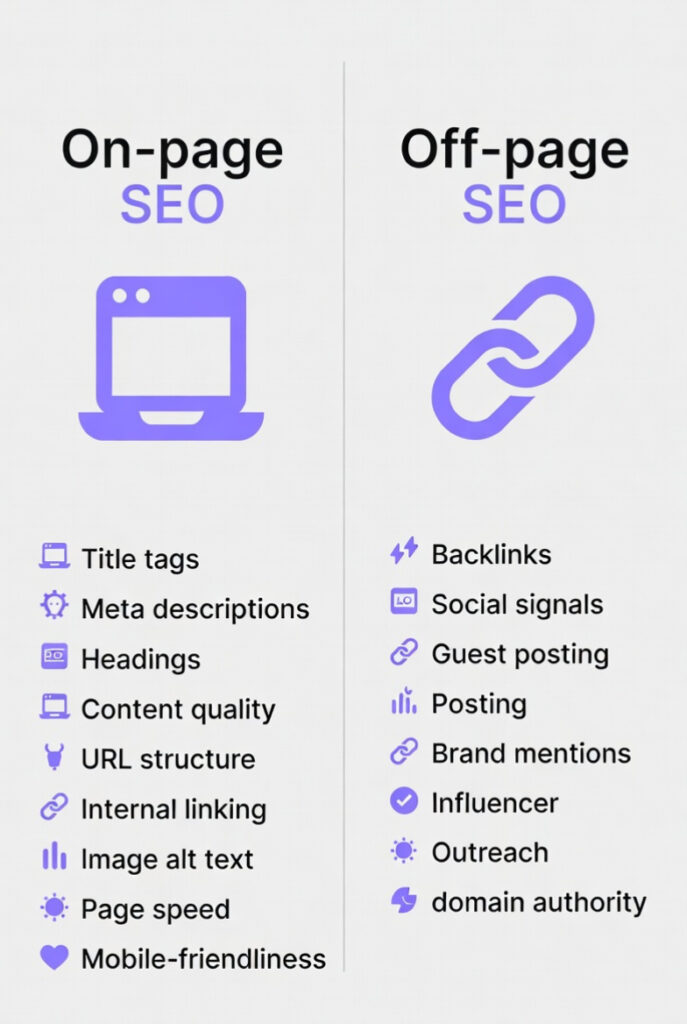
Off-page vs On-page SEO
This is where we draw the line in the sand. It’s actually pretty simple.
On-page SEO is everything you have total control over. It’s the stuff on your server. You decide the keywords, you write the content, you fix the page speed, and you structure the internal links . It’s about making your site relevant and user-friendly.
Off-page SEO is everything you don’t control. It’s how the external world perceives and interacts with your site. You can influence it, but you can’t command it. It’s about making your site authoritative and trustworthy .
Here’s a quick cheat sheet to keep it straight:
- On-Page: You write a killer blog post about “vegan recipes.”;
- Off-Page: A popular food blogger links to your post because they loved your recipes;
- On-Page: You optimize your title tag to include “best vegan recipes.”;
- Off-Page: Someone tweets about your “best vegan recipes” and their followers click through;
- On-Page: You fix your site’s mobile responsiveness;
- Off-Page: A local news site mentions your restaurant in a “Best of City” roundup.
One makes you relevant to the query. The other makes you credible enough to be the answer. You need both. It’s a symbiotic relationship. You can’t have one without the other and expect to dominate the first page.
What is More Important: On-Page or Off-Page SEO?
Honestly? That’s like asking if a heart is more important than a brain. They serve different, equally vital functions.
If your on-page SEO is weak, if your content is thin or your site is slow and people will bounce as soon as they land there. A high authority site with a terrible user experience won’t convert. It’s a waste of visibility.
If your off-page SEO is weak and if you have zero backlinks and no one mentions you, Google has no reason to trust you. You might have the most amazing content on the planet, but it will sit there unread, buried on page 10 of the search results.
In the early days of a website, you might focus slightly more on on-page SEO to get your foundation right. But to truly compete, you must build a robust off-page strategy. For competitive terms, off-page signals (specifically backlinks) are consistently cited by SEO professionals as the strongest ranking factor. They work in tandem. Great content (on-page) makes link building (off-page) easier. Strong links (off-page) make your great content (on-page) visible.
The Core Principles of a Modern Off-Page SEO Strategy
Forget the old days of spamming comments and buying thousands of garbage links. Those tactics will get you hit with a penalty faster than you can say “negative SEO.” Modern off-page SEO is about being ethical, building real relationships, and providing genuine value.
Your strategy should be a diversified portfolio. You don’t put all your money into one stock, and you don’t put all your off-page efforts into one tactic. Here are the core pillars you need to build.
Link Building
This is the granddaddy of them all. Link building is the practice of acquiring hyperlinks from other websites to your own. But not just any links—high-quality, relevant, dofollow links. A dofollow link passes authority; a nofollow link (often used in comments or sponsored posts) tells Google not to pass that authority, though it can still drive traffic .
- Broken Link Building: This is a classic, ethical tactic. You find a relevant, high-authority site in your niche. You use a tool like Ahrefs or Check My Links to find broken links on their site (links that lead to a 404 error page) . Then, you create (or point them to) a piece of content on your site that would be a perfect replacement for that dead page. You reach out to the site owner, tell them about the broken link, and suggest your content as a fix. It’s a win-win. They fix their user experience, and you get a backlink;
- Resource Page Link Building: Many websites curate lists of the best resources in an industry. You can find these pages by searching for terms like your keyword + “resources” or “helpful links.” If you have a genuinely useful tool, guide, or piece of content, you can pitch it to the curator for inclusion . It’s a direct ask, but if your stuff is good, they’ll often say yes;
- The Skyscraper Technique: Find popular content in your niche. Create something even better—more comprehensive, more up-to-date, better designed. Then, reach out to everyone who linked to the original, weaker piece of content and show them your superior version. It takes work, but the conversion rate can be solid.
Brand Mentions
Here’s a secret the pros know: brand mentions are the new backlinks—or at least, they’re becoming almost as powerful. Even when someone mentions your brand without a link (an “unlinked mention”), Google can register that as a positive signal. It shows you’re part of the conversation .
Brand mentions are a measurable KPI . They fuel brand authority.
- Link Reclamation: This is the easiest win in the book. Use tools like Google Alerts, Moz, or Semrush to monitor the web for unlinked mentions of your brand name . When you find one—say, a blogger wrote a roundup of cool companies and included you but forgot to link—send a friendly email. “Hey, thanks for the mention! If you want to link to our site, here’s the URL.” Most people are happy to do it. It’s a low-hanging fruit.
- Digital PR: This is about getting your brand in front of journalists and editors. Use platforms like HARO (Help a Reporter Out) to respond to queries from reporters writing stories . If you can provide an expert quote, data, or insight, they might include you in their article on Forbes, Business Insider, or a niche trade publication. That one mention (and likely a backlink) can be worth its weight in gold.
Content Marketing and Guest Posting
You need a reason for people to link to you. That reason is content. But it can’t be just any content. It needs to be linkable assets .
- Linkable Assets: These are pieces of content specifically designed to attract backlinks. Think original industry reports with proprietary data, interactive quizzes, free templates and tools, or deeply researched long-form guides. Stuff that’s so good, people have no choice but to reference it;
- Guest Posting: Writing for other reputable websites in your niche is still a powerhouse tactic . It gives you a backlink (usually in your author bio or within the content itself) and exposes you to a new audience. But you have to bring the heat. No thin, spun garbage. You need to write something that the host site’s audience will genuinely love. Search for “write for us” + your keyword to find opportunities;
- Podcasts and Webinars: Appearing as a guest on a popular podcast in your industry is a form of content marketing that builds massive credibility. You usually get a link in the show notes, and the host’s endorsement is far more powerful than a standard ad.
Social Media Engagement
Does a tweet directly impact your rankings? The official line from Google is no. But to ignore social media in an off-page strategy is to fight with one hand tied behind your back.
Social signals — shares, likes, comments — amplify your content’s reach. When your content gets shared widely on LinkedIn, Facebook, or X, it’s seen by more people. Some of those people might be bloggers or journalists who will then link to it . It’s the catalyst for link building.
Plus, your social media profiles themselves rank in search. When someone searches for your brand, your LinkedIn and Facebook pages often appear right there on the first page. You want to control that narrative. It’s about visibility and reputation management. Engaging in niche Reddit communities or answering questions on Quora also builds brand recognition and can drive targeted traffic back to your site .
Local SEO
If you have a physical location or serve a specific geographic area, local SEO is your lifeline. It’s a specialized branch off-page that focuses on dominating local search results.
- Google Business Profile (GBP): This is non-negotiable. Your GBP listing is your digital storefront on Google Maps and local search. You must claim, verify, and optimize it with accurate info, photos, and posts;
- Local Citations: These are mentions of your business Name, Address, and Phone number (NAP) on other websites, like Yelp, Yellow Pages, or local chamber of commerce sites . Consistency is king. Your NAP must be identical across every single platform. If it’s “Main St” on one and “Main Street” on another, you confuse search engines and hurt your rankings;
- Online Reviews: Managing your online reputation is a full-time job. Actively ask happy customers to leave reviews on your GBP listing. Respond to every review—good and bad. This shows you’re engaged and builds trust with both users and Google;
- Local Partnerships: Get involved in your community. Sponsor a local little league team or a charity event. You’ll often get a mention and a link from their website. It’s great for brand awareness and local search relevance.
How to Measure Off-Page SEO Success
You can’t manage what you don’t measure. Off-page isn’t a “spray and pray” activity. You need to track your progress.
- Backlink Profile Growth: Use tools like Moz (to check Domain Authority), Ahrefs (to check Domain Rating), or Semrush to track the number of referring domains pointing to your site . One link from 50 different high-quality sites is far better than 50 links from one site. You want to see this number grow over time;
- Referral Traffic: Head over to Google Analytics. Look at the “Acquisition” section and check “Referrals.” Which websites are sending you traffic? Are those numbers going up as you build more links? This shows your off-page work is actually driving business results;
- Branded Search Volume: Use Google Search Console or keyword tools to see if more people are searching for your brand name. An increase in branded search queries is a direct result of growing brand awareness through off-page activities;
- Keyword Rankings: This is the bottom line. Are the pages you’re building links to moving up in the rankings for their target keywords? Track your positions over time. You should see a correlation between a new high-quality backlink and a bump in rankings;
- Link Audit: Regularly audit your backlink profile. Use Semrush or Ahrefs to check your “Toxic Score.” If you see a bunch of spammy, low-quality links pointing to you, you can use Google’s Disavow Tool to tell Google you don’t want those links counted. This protects you from negative SEO attacks.
Off-Page SEO FAQs
Is Off-Page SEO Still Relevant Today?
Absolutely. More relevant than ever. While the tactics have evolved, the core principle remains: search engines need external validation to trust you. In an age of AI-generated content, off-page signals like backlinks and brand mentions are critical proof points of human-derived authority and trust.
Which is More Important On-Page SEO or Off-Page?
They aren’t in a competition. They are partners. On-page SEO makes your site relevant and usable. Off-page SEO makes it trusted and famous. You cannot achieve maximum visibility without both. Think of them as two legs you need to stand on.
What is the Most Important Part of Off-Page SEO?
If you had to pick one, the consensus is still high-quality backlinks from authoritative, relevant websites. They are the strongest, most direct ranking signal. However, the gap between links and brand mentions is closing fast. A holistic strategy that builds both is the only way to build lasting authority in the eyes of Google and emerging AI search platforms.
Related Posts
Ethan Parker
March 20, 2026
Off-Page SEO Checklist: Build Authority in 10 Steps
You built a beautiful website. The on-page SEO is tight. Headers flow, keywords sit naturally, and your content beats the…