
 Ethan Parker
March 25, 2026
Ethan Parker
March 25, 2026
How to Choose the Right Paid Media Channels?
Money talks. But in marketing, it screams. And if you throw that money into the wrong paid media channels, you…
Money talks. But in marketing, it screams. And if you throw that money into the wrong paid media channels, you are basically lighting cash on fire just to watch it burn. We see it happen more often than you’d think. Businesses get excited, they see a shiny new platform, and they dump the budget in without a second thought. Then they wonder why the return is flat.
The truth is, paid media is the fastest way to get your brand in front of eyeballs that actually matter. But speed without direction is just chaos. To make it work, you need to understand the landscape. You need to know which paid media channel fits your specific business goals, your audience, and your tolerance for risk. This isn’t about picking the most popular option. It’s about picking the right option.
What Are Paid Media Channels
Let’s get the basics straight.
Paid media channels are the avenues you pay for to get your content in front of people. It’s the opposite of organic. Organic is you waiting by the phone. Paid is you picking up the phone and dialing first. You are buying attention.
Think of it as renting space on someone else’s property. You don’t own it. But for a set amount of time — and a set amount of money — you get to broadcast your message. It could be a search engine. It could be a social media feed. It could be a banner on a website you’ve never heard of but that your customers visit daily.
Paid media covers a wide spectrum. We are talking about the obvious ones like Google Ads. But also the weird ones. Sponsored newsletters. Billboards in Times Square. Podcast ads read by a host in their pajamas. If there is a transaction involved to secure the placement, it qualifies.
The distinction matters because the strategy for each is wildly different. You cannot run a LinkedIn campaign like you run a TikTok campaign. One is a suit. The other is a dancing cat. Both can make money. But only if you treat them with the respect they deserve.
According to our data, most small businesses confuse “paid” with “easy.” They think if they just put money in, results come out. That isn’t how it works. Paid media channels require constant tweaking. They are alive. They breathe. And if you ignore them, they bleed your wallet dry.
Benefits Of Using Paid Marketing Channels
Why bother? Why not just grind out SEO for six months or hope your Instagram reel goes viral?
Because waiting is expensive, too. Time is a cost. Paid marketing channels collapse time. You don’t wait for the algorithm to like you. You buy your way to the front of the line.
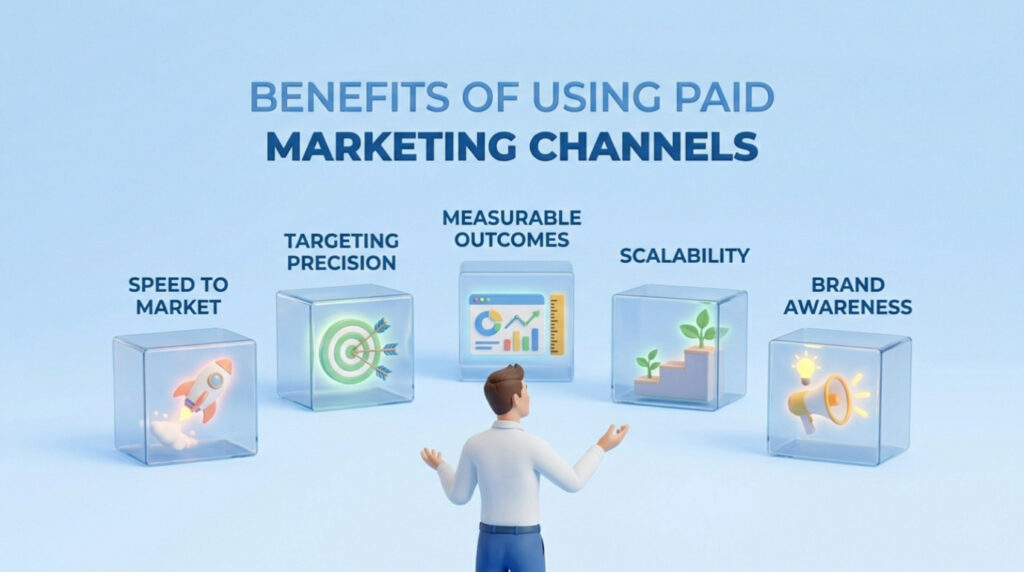
Speed to Market
This is the big one. You launch a campaign today, you can have traffic today. Not next week. Not after Google indexes your site. Today. For businesses that need cash flow now, that speed is everything.
Targeting Precision
You can get weirdly specific. Want to show ads only to left-handed architects in Portland who read a specific magazine? You can probably do it. The targeting capabilities in modern platforms are unsettlingly accurate. You can target by job title, income level, recent life events, or even the type of device someone uses. It’s not just casting a net. It’s spearfishing.
Measurable Outcomes
Organic is fuzzy. You see traffic go up, but why? A blog post? A mention in a forum? With paid media, the data is right there. You know exactly how much you spent. You know exactly how many people clicked. You know the cost per acquisition. There is no guesswork. If the math works, you scale. If it doesn’t, you stop. Simple.
Scalability
When organic is working, scaling it is hard. You need more content, more links, more time. With paid, you just add a budget. Obviously, there are limits. Platforms cap out. Audience saturation happens. But generally, if the return is positive, you can turn a $1,000 campaign into a $100,000 campaign in a week.
Brand Awareness
People act like awareness is just a vanity metric. It’s not. Sometimes you need people to know you exist before they will ever buy. Paid marketing channels put your logo in front of faces repeatedly. Even if they don’t click, the familiarity builds. Later, when they need what you sell, your name is the one that feels safe.
Types Of Paid Marketing Channels
The ecosystem is vast. But we can break it down into a few buckets. Each behaves differently. Each requires a different skill set.
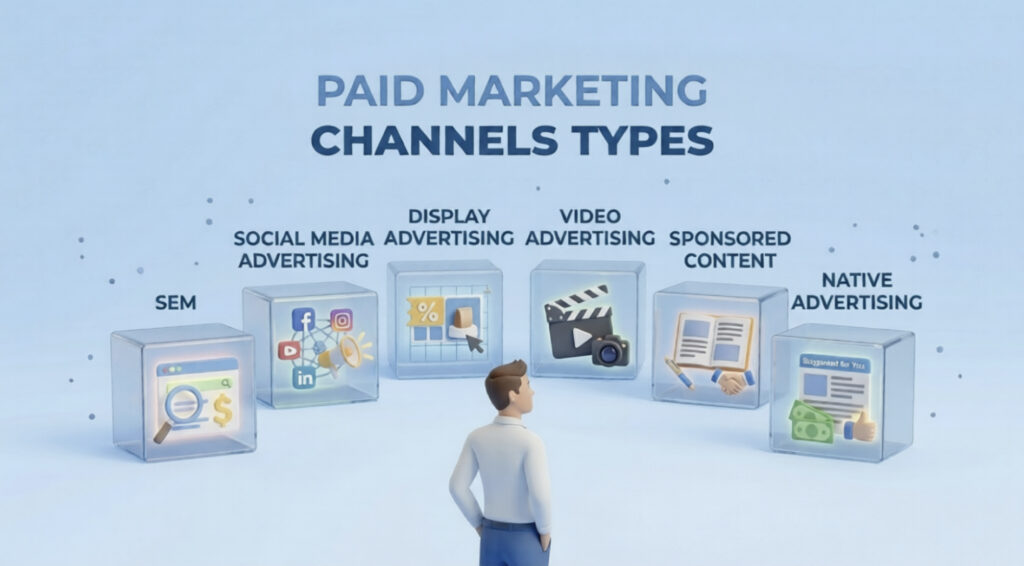
Search Engine Marketing (SEM)
This is Google, mostly. Bing exists, but let’s be honest about where the volume is.
- Search ads: Text ads that appear when someone types a query. Intent is high. If someone searches for “buy running shoes,” they are ready to buy. You pay for the click;
- Shopping ads: Product listings with images and prices. For ecommerce, this is often the best money you can spend. People see the product, the price, and the photo before they even click.
Social Media Advertising
Facebook and Instagram, LinkedIn, TikTok, X, Pinterest. The list never ends.
- Facebook & Instagram: The workhorses. Massive audience. Granular targeting. You can run video, images, carousels, or catalogs. According to our analysts, these platforms still deliver the best ROI for B2C, provided you have strong creativity. Weak creative dies here;
- LinkedIn: Expensive. Really expensive. But if you sell to other businesses, especially high-ticket services, the targeting by job title and company size is unmatched. You pay a premium for that precision;
- TikTok: The wildcard. Less about targeting data, more about cultural relevance. If your creative feels like an ad, you will lose money. If it blends in, you can explode.
Display Advertising
These are the banner ads. The ones that follow you around the internet after you look at a pair of shoes. Display advertising is often misunderstood. People say it doesn’t work. They are wrong. It works for retargeting.
You don’t use displays to get new cold traffic generally. You use it to haunt the people who already visited your site. It takes a user who was “maybe” and turns them into “fine, I’ll buy it.”
Video Advertising
YouTube is the world’s second-largest search engine. Video advertising is one of the paid media channels that most people overlook, as creating videos can seem like a daunting task.
You don’t need Hollywood productions. You need clarity. YouTube ads can be skippable. That sounds bad. But it’s actually a filter. If someone watches your ad for 30 seconds, they are qualified. You only pay if they watch a certain amount. It’s one of the cheapest forms of attention available right now.
Sponsored Content & Native Advertising
These are ads that look like articles. Taboola, Outbrain, or sponsored posts on publications like Forbes or The New York Times. The goal here is not to sell directly. It’s to build authority. You place a piece of content — a guide, a story — in a trusted environment. The reader doesn’t feel like they are being sold to. Until they click through.
How to Choose the Right Paid Media Channels
This is where the rubber meets the road. How do you actually pick?
We see companies spread themselves thin. They try to be everywhere. They end up being effective nowhere. Focus wins.
1. Start With your Audience, not the Platform
Where does your customer actually hang out? Not where you hang out. Not where the cool brands hang out. Where does your specific customer go?
If you sell industrial valves, TikTok is probably a waste of money. LinkedIn and niche trade publications make sense. If you sell luxury handbags, Instagram and Pinterest are non-negotiable. If you sell software to CFOs, you live on LinkedIn and YouTube (where they search for solutions).
Maybe the answer isn’t social at all. Maybe it’s a search. If your product solves a problem people actively search for, Google Ads should be your first stop. You don’t need to convince them they have a problem. They already typed it into a search bar.
2. Match the Channel to Your Funnel Stage
This is a mistake we see constantly. People run the same ad on every paid media channel and expect the same result.
- Top of funnel (awareness): Use visual platforms. TikTok, Instagram, YouTube, display. You are interrupting people. You need something entertaining or emotionally resonant. You are not asking for the sale yet. You are asking for a second of their time;
- Middle of funnel (consideration): Use search and retargeting. They know you exist. Now they are comparing. Search ads catch them when they research. Retargeting reminds them you are still there;
- Bottom of funnel (conversion): Use shopping ads, branded search terms, and email retargeting. These people are ready. You just need to remove friction.
3. Understand Your Margin
This is hard math. You cannot run paid media if your margins are too thin.
Let’s say you sell a product for $50. Your profit is $20. If your cost per acquisition (CPA) on Google is $25, you lose $5 every time you make a sale. That’s bad business.
But maybe on TikTok, the CPA is $15. That works. Or maybe on LinkedIn, the CPA is $50, but the lifetime value of that customer is $500. That also works.
You have to know your numbers. Cost per click means nothing. Cost per acquisition is everything. According to our data, the biggest reason campaigns fail is not the creative. It’s a fundamental mismatch between the cost structure of the channel and the profit margin of the business.
4. Test With a Small Budget
You don’t need to bet the farm on day one.
Take a paid media channel you are curious about. Put in $500. Run it for a week. Look at the data. Is the click-through rate above 1%? Is the cost per lead acceptable? If the answer is no, you either fix the creative or you kill it. Do not throw good money after bad.
We like to run three tests at a time. One search. One social. One wildcard (like a podcast or newsletter). See which one bites. Then you double down on the winner.
5. Consider Your Creative Capacity
This is the part people forget. Different paid marketing channels demand different creative assets.
- Google Ads needs text. Lots of headlines. Lots of descriptions. It’s copywriting heavy;
- Facebook and Instagram need images and short video. If you can’t produce a decent photo or a 15-second clip, you will struggle;
- TikTok needs native video. It needs trends. It needs speed. If your production cycle is two months, TikTok will eat you alive.
Honestly, you should pick channels that match your internal strengths. If you have a great writer but no videographer, go heavy on search and LinkedIn. If you have a creative team that lives in After Effects, go heavy on video. Don’t fight your own skill set.
6. Analyze the Saturation
Some channels are crowded. Google Ads for “insurance” or “lawyer” costs $50 to $100 per click. That is a shark tank. If you are a new brand with no reputation, entering those auctions is suicide.
But maybe a less obvious paid media channel is wide open. Maybe a niche newsletter. Maybe a podcast in your industry. Maybe Pinterest. The cost is lower. The competition is asleep.
You want to find the gap. The place where your competitors are not looking. According to our analysts, the biggest opportunities right now are in YouTube (pre-roll ads are still undervalued) and audio (Spotify ads are cheap because nobody is doing them right).
7. Use the Data to Kill Your Darlings
This is the hardest part. You might love Instagram. You might have a personal affinity for it. But if the data says your audience converts better on Pinterest, you go to Pinterest. Feelings don’t matter. Results do.
Set a timeline. 30 days is usually enough to see a signal. If the cost per acquisition is not within 20% of your target, cut it. You can always come back later with a new strategy. But holding onto a losing paid media channel just because you like the interface is a luxury you cannot afford.
Choosing the right paid media channels is not about following trends. It’s about honesty. Honesty about your audience. Honesty about your budget. And honesty about your creative abilities.
Maybe you only need one channel. That is fine. We see plenty of businesses built entirely on Google Shopping. Or entirely on LinkedIn. You don’t need a dozen plates spinning. You need one or two plates spinning really, really well.
Test fast. Spend smart. And when you find something that works, pour gasoline on it.
Related Posts
Ethan Parker
March 25, 2026
The PPC Optimization: Tips and Checklist to Increase Conversions
Your PPC campaigns are running. Money is leaving your account. Clicks are coming in. But conversions? Not so much. This…
Ethan Parker
March 24, 2026
Paid Media Management Explained: Goals, KPIs, and Best Practices
Paid media management isn’t just about spending money. It’s about controlling the narrative with precision. In a digital landscape where…
Ethan Parker
March 23, 2026
What is Paid Media? Definition, Benefits, Tactics and Examples
You’ve seen it a thousand times. The sponsored post that stops your scroll. The text ad is sitting pretty at…
Ethan Parker
March 25, 2026
What is PPC? A Beginner’s Guide to Pay-Per-Click Advertising
You type something into Google. You hit enter. The first few results at the top have a tiny “Ad” label…
Ethan Parker
March 24, 2026
How to Build a Paid Media Strategy for Maximum ROI
You can throw money at ads. That is not a strategy. A paid media strategy is something else entirely. It…