

 Ethan Parker
March 23, 2026
Ethan Parker
March 23, 2026
Paid Media Management Explained: Goals, KPIs, and Best Practices
Paid media management isn’t just about spending money. It’s about controlling the narrative with precision. In a digital landscape where…
Paid media management isn’t just about spending money. It’s about controlling the narrative with precision. In a digital landscape where organic reach has become a myth for most brands, the difference between a thriving business and a struggling one often comes down to how well you handle your paid ads. But throwing money at Google Ads or boosting a Facebook post doesn’t guarantee a 200% return. It guarantees a bill. The art and science of paid media management sits at the intersection of creativity, analytics, and sheer financial discipline.
We think of it as the engine room of modern marketing. If you’re running a business today, you are either a master of your paid advertising campaigns, or you’re paying someone else to clean up the mess. This article breaks down exactly what goes into professional paid media, from the initial strategy to the granular metrics that separate the pros from the amateurs.
What is Paid Media Management
To define paid media management, you have to look past the surface definition. It’s easy to say it’s the process of handling advertisements. That’s boring. More accurately, it’s the systematic control over digital real estate. You are renting attention. But unlike traditional billboards where you hoped the right car drove by, modern paid media allows you to dictate exactly who sees your message, when they see it, and what they do after.
It is a cyclical process. It starts with planning. You define the battlefield. Then comes executing—launching the campaigns. Then, and this is where most people fail, comes the relentless optimising. You don’t set and forget paid ads. You nurture them. You feed the winners and kill the losers. Finally, compiling reports isn’t just about showing numbers to a boss; it’s about gathering intelligence for the next cycle.
Paid Media Management Short Definition
Paid media management is the strategic allocation of budget across digital platforms to acquire attention, drive conversions, and maximize ROI through continuous optimisation and audience targeting.
That’s it. It’s the job of making sure every dollar of your marketing budget works harder than the last one. If you aren’t actively managing it daily, you aren’t managing it at all—you’re just donating to Google and Meta.
Goals of Professional Paid Media Management

Why hire a paid media agency or build an internal team? Because the goals of this discipline go far beyond “getting clicks.” Professional management focuses on a hierarchy of objectives that align with business survival.
Clear goals are the foundation. Without them, you’re sailing without a compass. We see this constantly with new clients who come to us saying, “We just want more traffic.” More traffic is a vanity metric. The goals need to be sharper.
Brand Awareness
First, there is brand awareness. This is top-of-funnel work. It’s about getting your name in front of a cold audience. You use paid media here to plant a flag. It’s expensive in the short term, but it builds the retargeting pool for later. According to our analysts, brands that neglect awareness eventually see their conversion costs skyrocket because they run out of warm leads.
Conversion
Second, and usually the primary goal, is conversion. You want the user to take action—buy a product, fill out a form, book a consultation. Professional management shifts the focus from impressions to actions. We obsess over the “last click” attribution, but smart teams look at the entire path.
Effective Budgeting
Third is efficiency. This is often unspoken, but it’s the most critical goal. It’s the drive to lower the cost per acquisition (CPA) while scaling volume. This is where budgeting becomes an active strategy rather than a limitation. You don’t just set a cap; you allocate based on performance. If one channel is delivering a 200% return, you feed it until the marginal cost meets the average cost.
Data Generation
Finally, there is data generation. Running paid ads is the fastest way to generate insights about your market. You learn what language resonates. You learn which offers fall flat. You learn the target audience’s tolerance for price. Good paid media management isn’t just about the immediate sale; it’s about the intelligence gathered to inform the entire business.
Essential KPIs for Measuring Paid Media Success
Measuring success requires moving past the “I think it’s working” phase. You need hard numbers. But not all numbers matter equally. The KPIs you choose dictate how you optimize. Pick the wrong metric, and you’ll scale a campaign that looks good on paper but bankrupts the business.
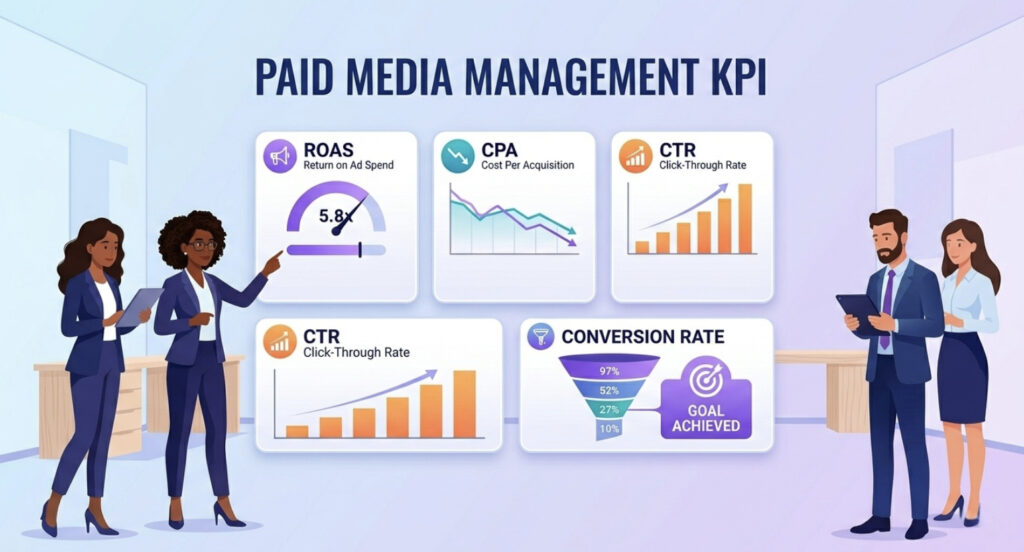
Here are the essential KPIs we track religiously:
- ROI: The king of metrics. It tells you if you’re making money or losing it. Simple calculation: (Revenue – Cost) / Cost. If you aren’t tracking this, stop everything and fix your tracking and analytics setup. Without this, you are gambling;
- CTR: This is a measure of relevance. It tells you if your ad creative and copy is compelling enough to stop the scroll. A low CTR usually means your hook is weak or your audience targeting is off. Google Ads punishes low CTRs with higher costs, so this metric directly impacts your budget efficiency;
- CVR: This is the percentage of clicks that turn into a goal completion. This is a measure of your landing page and offer strength. You can have the best paid media in the world, but if your landing page loads slowly or your call to action is confusing, you will waste the traffic;
- CPA: Also called Cost Per Conversion. This is your efficiency metric. It answers the question: “How much did it cost to buy that customer?” If your CPA is higher than your customer lifetime value (LTV), you have a math problem that no amount of optimisation can fix;
- Impression Share: Specifically for platforms like Google Ads and LinkedIn. This tells you what percentage of the available auctions you are winning. If you have a high impression share but low ROI, you might be bidding too much. If it’s low, your budget is too restrictive or your quality score is too low.
We look at these numbers daily. Not weekly. The landscape moves too fast. A sudden spike in CPA on a Tuesday morning could indicate a competitor entered the auction. If you wait until Friday to look at the report, you’ve already wasted a week’s budget.
Best Practices for Paid Media Management
Getting paid media management right requires a specific methodology. It’s not about being the smartest person in the room; it’s about being the most disciplined. Here are the non-negotiable best practices we’ve developed over years of managing millions in ad spend.
Start with Clear Goals and Platform Selection
You cannot pick the platform until you know the goal. B2B companies often live and die by LinkedIn. It’s expensive, but the audience targeting by job title is unmatched. If you are selling software to CFOs, you go to LinkedIn. But if you are selling consumer goods, Facebook and Instagram are the battlegrounds. TikTok is for brand awareness and capturing Gen Z. Google Ads is for capturing intent—people who are actively searching for what you sell.
Choosing the wrong platform is the fastest way to kill a campaign. We’ve seen ecommerce brands blow budgets on LinkedIn because they liked the “professional” vibe, only to get zero sales. Match the platform to the psychology of the buyer.
Rigorous Audience Targeting
This is the foundation. Audience targeting is where you make or break your efficiency. You can have the best ad creative in the world, but if you show it to the wrong person, it’s noise.
Modern paid media offers layers of targeting:
- Demographic: Age, location, gender;
- Interest-based: What they like, what they follow;
- Behavioral: Recent purchases, device usage;
- Retargeting: People who have already visited your site;
- Lookalike: People who resemble your existing customers.
The mistake amateurs make is going too broad. “We want to reach everyone.” No, you don’t. You want to reach the 0.5% of the population who are actually looking for what you sell. Hyper-specific targeting reduces waste and improves ROI.
The Discipline of A/B Testing
If you aren’t A/B testing, you aren’t optimizing. You are guessing. A/B Testing should be a constant state of being.
Test one variable at a time. Run two identical ads, but change the call to action. Run two landing pages, but change the headline. Run two audience targeting sets, but keep the creative the same.
We’ve seen a simple color change on a button increase conversion rates by 30%. We’ve seen a shift from “Sign Up” to “Get Free Access” cut the CPA in half. You don’t know what works until you test. According to our data, campaigns that run fewer than three active A/B tests at any given time tend to stagnate in performance within six weeks.
Obsess Over Ad Creative and Copy
We mentioned ad creative and copy earlier, but it deserves its own spotlight. The algorithms are getting smarter, but they still need raw materials to work with. If your visuals are boring or your messaging is generic, the algorithm has nothing to optimize.
Your creatives must stop the scroll. In a world of infinite feeds, you have maybe 0.5 seconds to grab attention. Use bold colors. Use movement. Use faces. As for the copy, speak directly to the pain point. Your headline should not be clever; it should be clear. Your call to action should be urgent. “Learn More” is weak. “Start Saving Now” is stronger.
We also recommend refreshing creative every 2-3 weeks. Ad fatigue is real. Users on Facebook and Instagram will start ignoring your ad after they’ve seen it a few times. Keep the visuals fresh to maintain a healthy CTR.
Common Paid Media Management Mistakes to Avoid
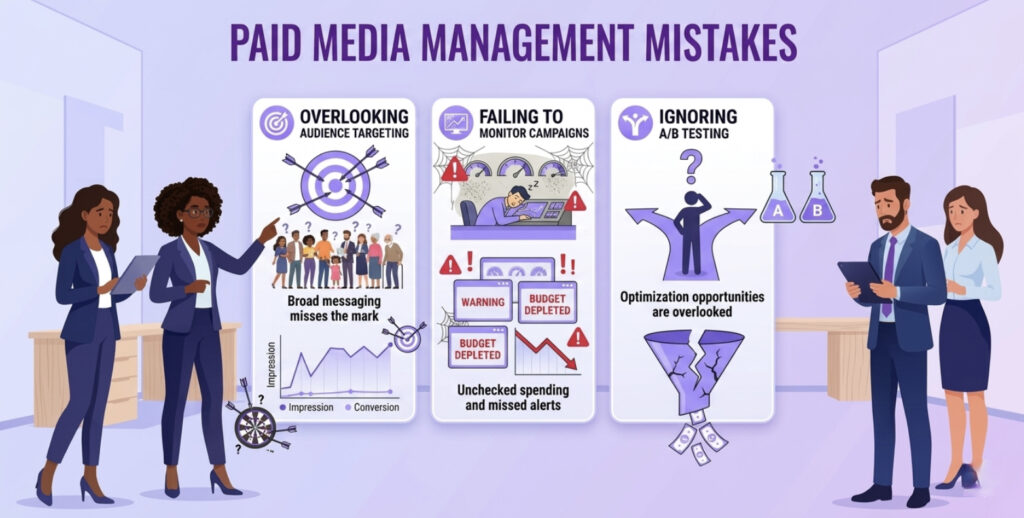
Even experienced marketers fall into traps. The complexity of paid media means there are a thousand ways to leak budget. Here are the common missteps we see every week when auditing accounts.
Overlooking Audience Targeting
We see this constantly. A business sets up a campaign, selects “United States” as the location, and hits launch. They end up spending thousands of dollars on clicks from teenagers in rural areas who have zero interest in their high-ticket B2B service.
Overlooking audience targeting is the number one cause of wasted spend. You have to use the tools. Exclude existing customers. Exclude irrelevant demographics. Use negative keywords in Google Ads to stop your ad from showing when someone searches “free” or “cheap” if you are a premium service. Narrow the field.
Failing to Monitor Campaigns
Launching a campaign is not the end of the job; it’s the beginning. Failing to monitor campaigns is like planting seeds and never watering them. You need to be in the dashboards.
We recommend a “three-check” system:
- Morning: Check spend pacing. Are you on track to hit the budget without overspending by 3 PM?
- Afternoon: Check performance metrics. Is the ROI holding? Are there any alerts from Google or Meta?
- Night: Review A/B test results. Kill the losing variants immediately.
If you aren’t doing this, your paid ads will drift. Costs will creep up. ROI will slide. And you won’t notice until the monthly report arrives, at which point the money is already gone.
Ignoring A/B Testing
This ties back to the best practices, but the mistake is treating A/B testing as optional. It’s not.
We’ve audited accounts where the same ad creative ran for six months. The CTR had dropped by 80%, but the manager didn’t notice because they only looked at conversion volume. Ignoring A/B Testing leads to stagnation. The platforms want to see new content. If you stop testing, the algorithms will deprioritize your ads, and your costs will rise. It’s a hidden penalty for laziness.
Underestimating the Importance of Creative
Here’s a controversial take: the algorithm does 40% of the work. Your budget does 20%. The ad creative and copy does the remaining 40%. Yet, we see businesses spend 90% of their time fiddling with bidding strategies and 10% on visuals.
Underestimating the importance of creative is a death sentence. If your paid media management team doesn’t include designers or copywriters, you are operating with one hand tied behind your back. You cannot optimize a bad ad into a great ad. You can only polish a turd. Invest in high-quality visuals. It’s the cheapest leverage you have.
The Future of Paid Media Management
What does the next five years look like? If you are looking at paid media management as a static skill set, you will be left behind. The landscape is shifting under our feet, driven by AI and privacy regulations.
Tracking And Analytics
First, the tracking and analytics landscape is fundamentally changing. With the deprecation of third-party cookies and the tightening of privacy controls on iOS, the old days of perfect attribution are over. We are moving into a world of modeled conversions and aggregated event measurement. The future of paid media relies less on “last click” data and more on incrementality testing. You need to know if your ads are actually generating new business, not just claiming credit for organic sales.
AI Implementation
Second, AI is becoming the execution layer. Google’s Performance Max and Meta’s Advantage+ campaigns are switching to ‘black-box’ optimisation. You give them your budget, your creatives, and your audience targeting suggestions, and the AI decides where to show the paid ads.
This is a double-edged sword. It lowers the barrier to entry, but it raises the bar for strategy. The AI still needs high-quality inputs. The future of paid media management is less about manual bidding and more about strategic platform selection, creative production, and data interpretation. The manager of the future is a hybrid: part data scientist, part creative director.
Platform Diversification
Third, platform selection is diversifying. It’s not just Google and Meta anymore. We are seeing massive shifts toward retail media (Amazon, Walmart) and connected TV (CTV). TikTok is maturing into a serious conversion engine, not just a playground for trends. Bing, often ignored, is gaining share as Microsoft integrates AI search features.
The businesses that succeed will be those that treat paid media as a dynamic system, not a static campaign. They will embrace continuous improvement. They will demand measurable returns. And they will recognize that you cannot do this alone. Whether you build an internal team or hire a paid media agency, the key is to treat the discipline with the respect it deserves.
If you take away one thing from this, let it be this: paid media is the most scalable customer acquisition channel available to modern businesses. But it is a fire hose, not a drinking fountain. Without proper management — without clear goals, relentless optimisation, and a deep respect for the data — it will wash you out. With it, you can achieve a level of growth that organic channels simply cannot match.
Related Posts
Ethan Parker
March 23, 2026
What is Paid Media? Definition, Benefits, Tactics and Examples
You’ve seen it a thousand times. The sponsored post that stops your scroll. The text ad is sitting pretty at…
Ethan Parker
March 24, 2026
How to Build a Paid Media Strategy for Maximum ROI
You can throw money at ads. That is not a strategy. A paid media strategy is something else entirely. It…
Ethan Parker
March 25, 2026
The PPC Optimization: Tips and Checklist to Increase Conversions
Your PPC campaigns are running. Money is leaving your account. Clicks are coming in. But conversions? Not so much. This…
Ethan Parker
March 25, 2026
What is PPC? A Beginner’s Guide to Pay-Per-Click Advertising
You type something into Google. You hit enter. The first few results at the top have a tiny “Ad” label…
Ethan Parker
March 25, 2026
How to Choose the Right Paid Media Channels?
Money talks. But in marketing, it screams. And if you throw that money into the wrong paid media channels, you…